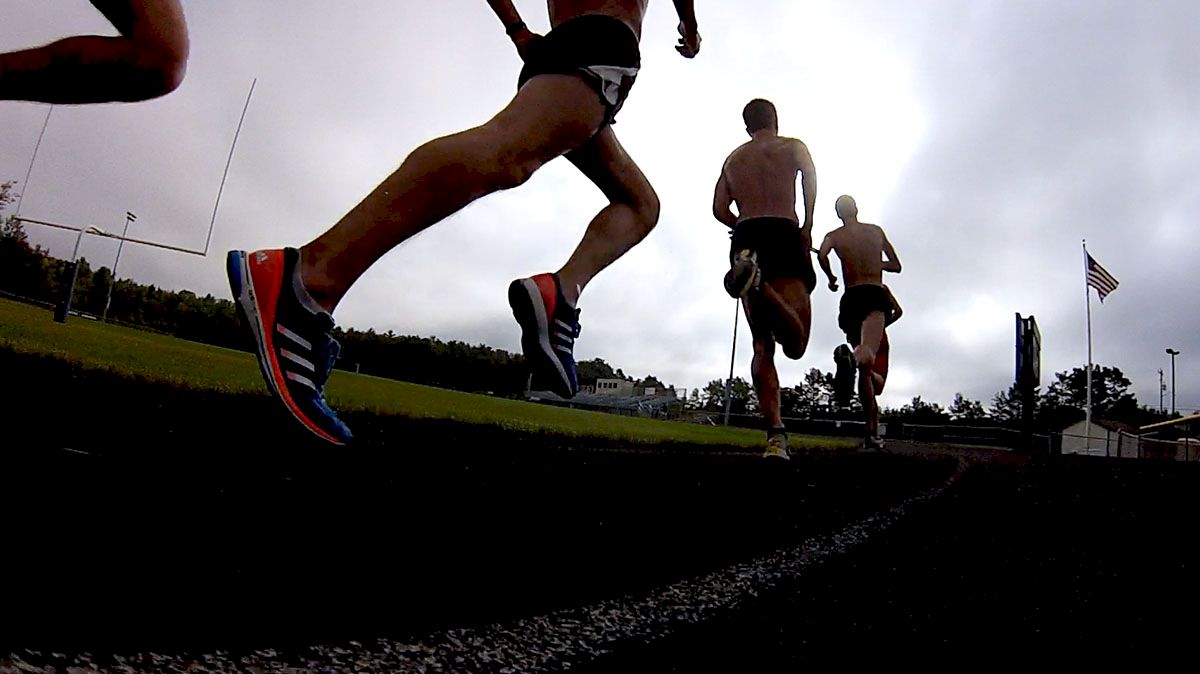
Almost anyone can run a marathon. Siri Terjesen just ran her 99th this weekend in Fort Worth, Texas. Terjesen, 32, from Akron, Ohio, is a professional ultrarunner who routinely runs marathons every few weeks as part of her training.
“I find it difficult to get out of bed for anything less than a marathon,†Terjesen joked.
Ultrarunning is underrated in the serious running community, often associated with slow jogging, insanity and publicity stunts.
“There are people who promote themselves over the sport,†Terjesen said, but she described most ultramarathoners as going “out of their way to bring new people into this sport. It’s an incredibly kind community.â€Â
While the ultrarunning community is supportive of each other, they can be competitive. Terjesen, who typically races the 50 km distance, has personal best times of 3:35:19 in the 50 km, 8:22:09 in the 100 km, and 2:57:31 in the marathon. She has competed on the English, American and Australian ultradistance teams. Terjesen has won more than 30 races in Spain, Belgium, Australia, the UK and the U.S. In 2006, she won the bronze medal at the 50 km World Championships, in Winschoten, Holland, which she said is one of her greatest accomplishments so far. That year, Terjesen was also the Australian National 50 km Champion, and won races ranging from the Brisbane Marathon to the Caboolture 6 Hour, where she was the overall winner.
“It’s not uncommon for women to outright win ultras,†she explained, due to their higher levels of body fat and pain tolerance.
Surprisingly, Terjesen only runs about 20 to 40 miles per week, with marathons covering the bulk of her mileage. She attributes her lack of running-related injuries to her low mileage, strength-training three times per week and running primarily on soft surfaces.
Although she is now healthy, Terjesen has had experience with a debilitating disorder, scoliosis, in her past. For nine years (age 7 to 16), she wore a full torso brace to correct her spine’s curvature. She was able to take it off for an hour each day to run during her first two years of high school. At age 16, the scoliosis had gotten worse, so Terjesen had surgery to implant two rods fused to her spine. Unfortunately, she was forced to stop running.
“I was too afraid to,†Terjesen said, “You aren’t even allowed to hop.â€Â
In 1997, when she was a senior at the University of Richmond, fate stepped in. Terjesen won a free trip to Switzerland. While there, she decided to run the Copenhagen Marathon after basing her training off of a “Runner’s World†magazine printout. It was then that she realized that she could handle longer distances.
“I was so happy to run after my surgery,†she said.
Terjesen’s positive attitude helps get her through the miles. She said she thinks about her accomplishments, friends and family.
“When you’re going that far you really have to manage your head,†she explained, “If you start to think about negative things, it’s easy to stop.â€Â
Nutrition and hydration are also important during ultradistance runs. Terjesen prefers to eat high-salt foods, coffee and flat Coke to keep her energy up while running for hours at a time. When she isn’t running, she said she used to believe she could eat anything she wanted, but now tries to make healthier choices with the help of a nutritionist.
Terjesen, whose longest race so far has been 100 km (62 miles), hopes to run 100 miles sometime in the future. She also said she would like to return to the World Championships and improve her personal best times.
Running is not Terjesen’s only job. Although she is sponsored by Brooks, there is little prize money in ultramarathons. Terjesen attended the University of Richmond (Virginia), the Norwegian School of Economics and Business Administration (Norway), where she was a Fulbright Scholar, and Cranfield University (UK). She has written for “Ultrarunning†and “AURA†magazines, organized marathons and running clubs. She currently teaches full-time as an assistant professor at the Neeley School of Business at Texas Christian University, in Fort Worth, Texas, and at the London School of Economics during the summer.
Since she does not have a team to train with, Terjesen mostly runs on her own. She said there are not many ultrarunners in the U.S. as in other parts of the world, but hopes that will change once people realize their misconceptions about the event.
“For the most part there aren’t many ultrarunners,†she said, “The real challenge is getting marathoners to step up the distance.â€Â
If you would like to know more about ultrarunning, Terjesen suggested reading “A Step Beyond: A Definitive Guide to Ultrarunning†and “Ultrarunning†magazine (http://www.ultrarunning.com/ultra/merchandise/a-step-beyonda-definitive.shtml), or contacting her by email (siriterjesen@yahoo.com).
Photo from brooksrunning.co.uk