Welcome Back, Christian Coleman: Rabat Diamond League Preview
Welcome Back, Christian Coleman: Rabat Diamond League Preview
After a brief layoff due to injury, Christian Coleman is hopping into an incredibly interesting 100m in Rabat.
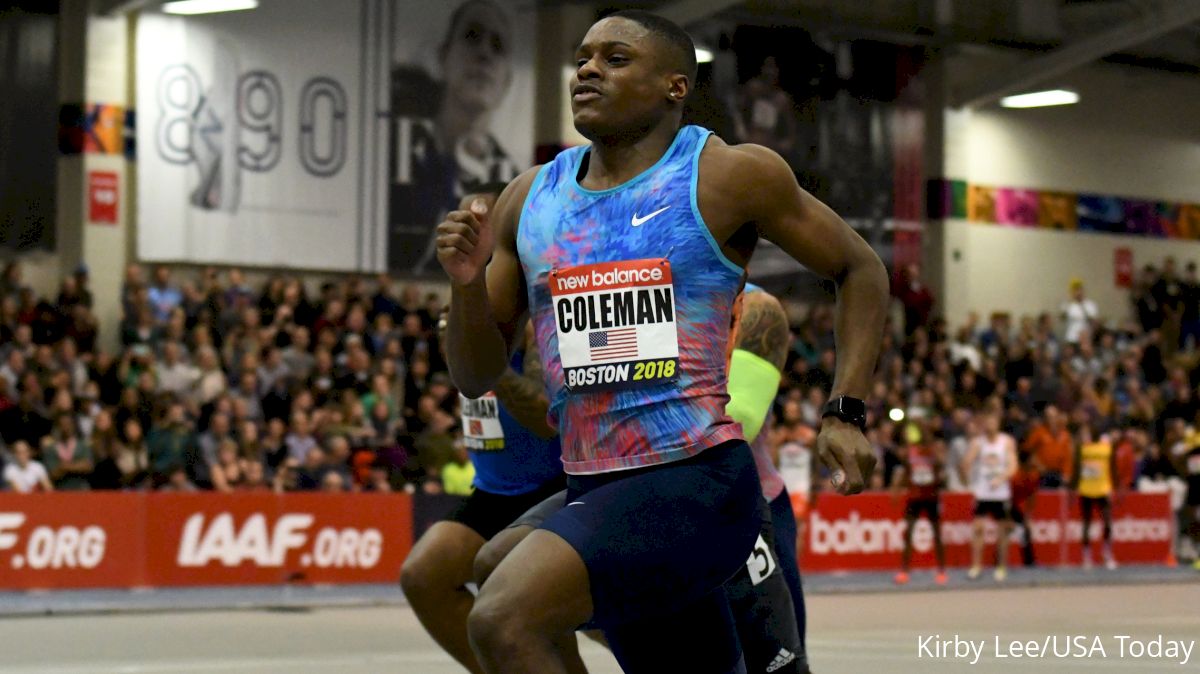
Christian Coleman has only been away from the professional circuit for six weeks. But time moves quickly in the sprint world, and month and a half has felt more like an entire season, particularly in the United States.
Since Coleman was sidelined with a hamstring injury, here’s what’s happened:
-Noah Lyles dropped down in distance to win the U.S. title, running a world-lead of 9.88.
-Ronnie Baker matched that time in Paris, where he recorded his third Diamond League victory of the year.
-Mike Rodgers didn’t run the final at USAs, but he put up a 9.89 in the opening round in Des Moines.
These are the men who will be greeting Coleman in his first race since he ran a 10.04 at the Rome Golden Gala meet to finish a disappointing fourth place. It’s a field that will do him no favors. The United States is the top sprint nation in the world right now and they are sending their best to Rabat. The event hasn’t moved on without Coleman (again, he’s only been gone for six weeks and the world lead is slower than his personal best), but it certainly has become more robust.
If Coleman is running on Friday it’s likely a sign that he is back to full health. There would be little to gain from racing him if he’s less than 100 percent in a season with such low stakes. But just because the injury is fully healed doesn’t mean he is race sharp, especially when compared to the three men above.
Baker and Lyles have been on a particular tear. Outside of his 9.88, Lyles has also clocked a pair of 19.69s on the season. Baker has won five of his six 100m finals this year. His only loss came to Lyles at the USATF Championships.
Regardless of the form that Coleman is in, we know that Lyles and Baker are close. And even if the three- (or four-) person battle doesn’t materialize this race will serve as a nice preview for what the U.S. sprint scene should look like for the next Olympic cycle.
Outside of the men’s 100m, here are a few other races to watch in Rabat:
Women’s 1000m: Can Caster Semenya Break The World Record?
It doesn’t have the prestige of the 800m, so it’s fitting that an attempt at the 1000m world record wouldn’t have the same type of hype.
But it seems doable that Semenya could surpass Svetlana Masterkova’s 2:28.98 from 1996. In the last two Diamond League races, Semenya ran distances on either side of the 1000m.
Her 800m in Paris was sensational—a 1:54.25 personal best. The 1500m didn’t go as well in Lausanne. She took sixth in a 4:00.44, the victim of a fast pace in the early laps. However, if Lausanne was a bit of over-distance work for this record than it served its purpose.
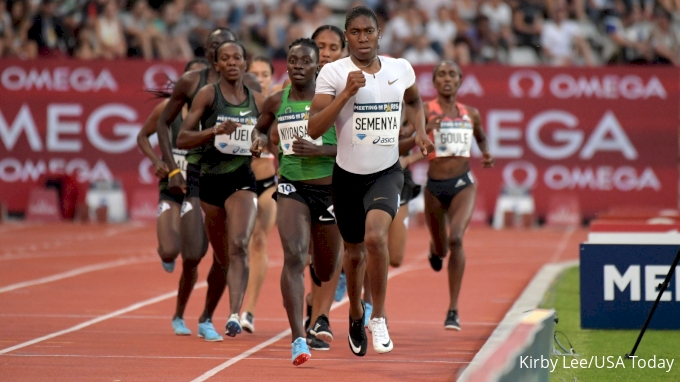
In March, Semenya ran 2:35 at altitude in South Africa so she has some experience in this distance. In many ways, the 1000m is a perfect fit for her at this point in her career. If she goes through 800m in 1:59 she only needs to close in just under 30 seconds to have the record. Now, the proposition of pacers bringing her through on schedule invites another series of complications. But if they can click off events splits for the 600m, Semenya can use that strength and speed that has made her so potent in the 1500m and 800m.
Women’s 5000m: Dibaba Returns To The 5000m
Genzebe Dibaba headlines this one and it has all the makings of a race that will break open early. Even if she runs a “conservative” pace of 14:30, there’s only a few in this field willing and able to try and run with that group. Beyond Dibaba, there are all the big names entered in this event—Sifan Hassan, Hellen Obiri, and Caroline Kipkirui.
Dibaba prevailed in her only other 5000m of the year, running 14:26.89 at the Prefontaine Classic and winning in vintage Dibaba perfunctory fashion. Letesenbet Gidey took second to Dibaba in that race and might prove to be her closest competition again on Friday.
Molly Huddle is running her first race since her 10,000m victory at the USATF Championships. There, she didn’t look like marathon training had dulled her speed at all—negative splitting the final mile after front-running the race. Her personal best of 14:42.64 is a high bar, especially with how disjointed this race should become.
Men’s 3000m: Can This Field Break 7:30?
This one is anyone’s guess. The Americans will trot out a lineup of Eric Jenkins, Paul Chelimo, and Ryan Hill, all of whom are capable of factoring in late in the race. Outside of the U.S., the entry list features virtually everyone you’d want in a race over this distance—Yomif Kejelcha, Birhanu Balew, Muktar Edris, Abdelaati Iguider, and Hagos Gebrhiwet. The most notable absence is Selemon Barega—both because of his talent on the track and because everyone wants to see him on the same track as Kejelcha after what happened last week.
When you try to pants your competition, but he ain't having any of it... pic.twitter.com/YjvlYUjDZ3
— FloTrack (@FloTrack) July 5, 2018
Chelimo has run 7:31 in the early stages of 2017 so there’s definitely reason to think he can run that fast again on Friday. The timing of the race and quality of field means we need to at least mention the possibility of him breaking the American record of 7:29.00. The odds are against it, but again, it’s a fast 3000m in mid-July that features multiple runners capable of breaking 7:30.
Men’s 400m: With Their NCAA Season In The Rear View, What Can Allen And Bloomfield Run In The 400m?
Because of injuries and collegiate schedules, this meet is missing some of the top names in the quarter. But the eight men assembled do comprise an interesting field.
If not for Michael Norman’s 43.61 at NCAA Championships, the accolades would have showered on Akeem Bloomfield. The Jamaican posted a huge personal best in Eugene, running 43.94 to finish second. Friday will be his second race since the collegiate season and his first outing (a 20.00 200m in Lucerne) is a promising sign.
He will be joined by his fellow Auburn Tiger in Rabat (both men went pro after the NCAA season). Allen has world championship experience and ran 44.13 for third place at NCAAs.
The Americans will be represented in the field by Michael Cherry and Paul Dedewo; those two finished two-three in the USATF Championships.
Men’s 1500m: Who Takes Advantage Cheruiyot’s Absence?
Without Timothy Cheruiyot and Elijah Manangoi, there’s space at the top of this field. Cheruiyot’s won Diamond Leagues in Shanghai, Eugene, Rome, and Paris, while Manangoi took the win in Oslo and finished in the top three in Eugene and Rome. It’s still a deep field with six men who have run under 3:35 this year, but not as top-heavy had the two Kenyans entered.
Ayanleh Souleiman could fill the void. He was second to Cheruiyot in Paris at the end of June and has rebounded from his sub-par 2017 season. Kenya’s Charles Simotwo isn’t as well-known as his countryman, but finished second to Cheruiyot at the Kenyan Championships and took third in Paris.
It will be interesting to see how Matthew Centrowitz fares after his latest U.S. 1500m title. Over the course of his career, he’s been much more successful in championship settings than the Diamond League (given the choice of the two, who wouldn’t take the former?). Rabat will be a chance to test himself in another time trial setting and perhaps get the first Diamond League victory of his career.
Women’s 200m: Miller-Uibo Preps For Monaco Showdown
Next week, Shaunae Miller-Uibo and Salwa Eid Naser will square off in the 400m. But first, Miller-Uibo will tune up with the Rabat 200m. Here, she will face short sprinters Murielle Ahoure, Blessing Okagbare-Ighoteguonor, and Jenna Prandini.
Even after her win in Lausanne last week, American Gabby Thomas is a longshot to take the victory against this field. But the competition provides her with an opportunity to improve on her lifetime best of 22.32. And after a season that has run for more than seven months (she’s run at least one meet every month since last December) that would be a huge accomplishment.