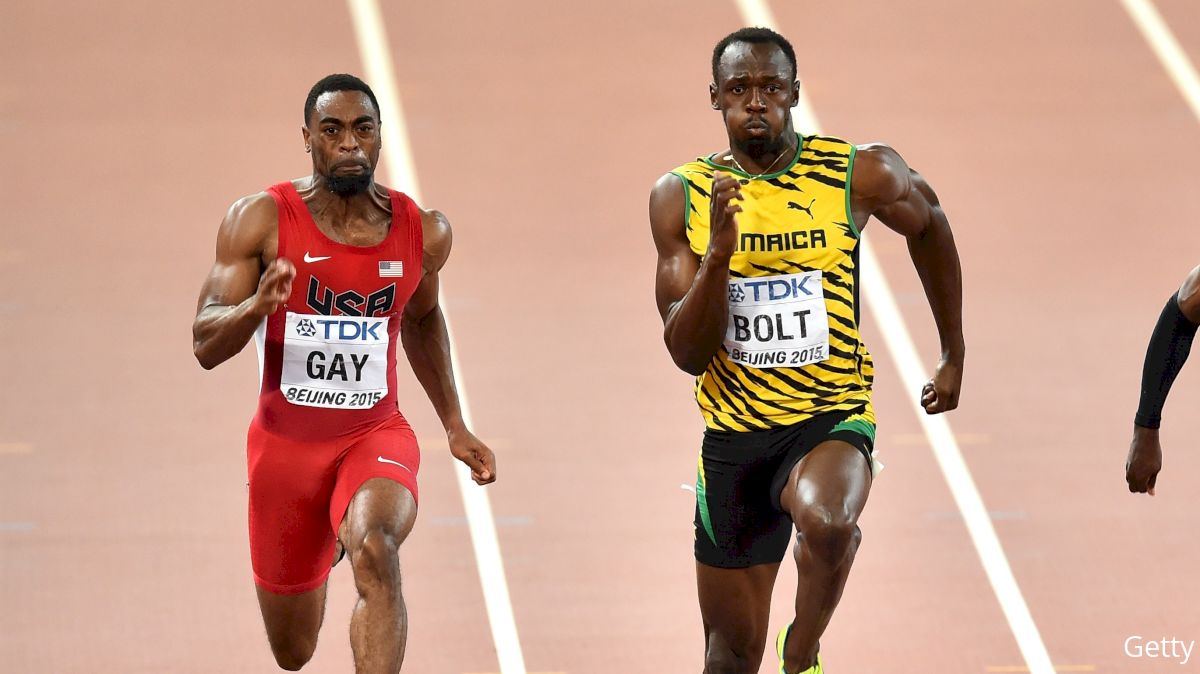
Celtics vs. Lakers. Yankees vs. Red Sox. USA vs. Jamaica. Rivalries like these don’t just define sports, they elevate them. They create storylines, tension, and moments fans never forget. In track and field, no matchup captures that energy more than the United States versus Jamaica.
The United States has long been the sport’s dominant force. Making the U.S. national team remains one of the hardest tasks in athletics, with Olympic and World medalists sometimes left off the roster due to its unmatched depth. But when it comes to the sprints, one nation has consistently risen to challenge America’s supremacy: Jamaica.
Early Foundations
The U.S. built its sprinting legacy with icons like Jesse Owens, Carl Lewis, Florence Griffith-Joyner, and Michael Johnson, athletes who made American dominance feel inevitable. Jamaica, meanwhile, produced individual stars across generations: Herb McKenley in the 1940s–50s, Don Quarrie in the 1970s, and Merlene Ottey from the 1980s into the 2000s. But for decades, Jamaica was viewed as the home of outliers rather than a rival program that could consistently go toe-to-toe with Team USA.
The Spark: Athens 2004 and Asafa Powell
That perception began to shift in 2004. At the Athens Olympics, Veronica Campbell-Brown won the 200m, upsetting the favorite- American Allyson Felix. Campbell-Brown then anchored Jamaica’s 4x100m relay team to its first-ever Olympic gold. What followed was the start of a back-and-forth rivalry between Campbell-Brown and Felix, who captured the 200m world title in 2007 and helped the U.S. reclaim relay dominance. The seeds of a true national rivalry had been planted.
Before Usain Bolt redefined sprinting, Asafa Powell was the Jamaican who carried the nation’s sprinting hopes. A former 100m world record holder, Powell consistently ran under 10 seconds throughout the mid-2000s, more than any other sprinter of his time. While he often fell short on the world stage his rivalry with American sprinters like Justin Gatlin and Tyson Gay was an early spark that set the tone for the explosive Bolt vs. Gay showdown that followed.
The Explosion: Beijing 2008
Everything changed in Beijing. Usain Bolt rewrote history with world-record performances in the 100m and 200m. Shelly-Ann Fraser-Pryce stunned the world by winning the women’s 100m, leading a Jamaican podium sweep with Sherone Simpson and Kerron Stewart sharing silver. Campbell-Brown defended her Olympic 200m crown. Jamaica also stormed to victory in the men’s 4x100m relay. For the first time, Jamaica wasn’t just producing stars, it was challenging the United States across multiple events on the biggest stage. Beijing 2008 is widely regarded as the birth of the USA vs. Jamaica sprint rivalry, one that has defined global championships ever since.
The Bolt Era
From 2008 to 2016, Usain Bolt’s dominance was unmatched, making him the global face of sprinting. His rivalry with American star Tyson Gay helped define the early years of this era. Gay, the 2007 World Champion, pushed Bolt to his limits, most memorably at the 2009 World Championships in Berlin, where Bolt shattered the 100m and 200m world records while Gay ran 9.71, the fastest losing time in history and American record at that point. Their clashes set the tone for a U.S. vs. Jamaica battle that transcended individuals and became a national rivalry.
Bolt wasn’t alone. Jamaica’s Yohan Blake and Nesta Carter added firepower, keeping the U.S. under constant pressure in both individual events and relays. On the American side, Allyson Felix and Carmelita Jeter carried the women’s rivalry. At the 2012 London Olympics, Felix won gold in the 200m, helped the U.S. smash the women’s 4x100m world record, and anchored the 4x400m to another victory. Jamaica answered with Shelly-Ann Fraser-Pryce, who stormed to gold in the 100m, and with their men’s 4x100m relay team (Bolt, Blake, Carter, and Michael Frater) also setting a new world record of 36.84 seconds.
The balance began to shift in 2017 at the World Championships in London. For the first time since 2007, Bolt was beaten on the global stage, as Americans Justin Gatlin and Christian Coleman took gold and silver in the 100m. It was a symbolic passing of the torch and the beginning of the post-Bolt era.
The Modern Era
Today, the rivalry is fueled by a new generation of stars carrying the torch for both nations.
On the women’s side, Jamaica continues to boast sprint legends like Shelly-Ann Fraser-Pryce (in her last season), Elaine Thompson-Herah (when healthy), Shericka Jackson, and Tia and Tina Clayton.
At the 2023 World Championships in Budapest, Sha’Carri Richardson stormed to her first global title in the women’s 100m, announcing her arrival on the biggest stage. That same week, Shericka Jackson delivered a historic performance in the 200m, running 21.41—the second-fastest time ever behind Florence Griffith-Joyner’s world record.
The American women’s depth is stronger than it has been in years: Gabby Thomas has established herself as one of the world’s best in the 200m, and Melissa Jefferson-Wooden heads into the 2025 World Championships as a favorite in the 100m. At the 2024 Paris Olympics, Richardson gave fans one of the rivalry’s most memorable moments when she anchored Team USA to gold in the 4x100m relay: staring down her British opponent as she crossed the finish line, a clip that instantly went viral.
On the men’s side, the U.S. has regained control. Noah Lyles has emerged as the face of global sprinting, sweeping the 100m and 200m at the 2023 World Championships. At the 2024 Paris Olympics, he cemented his legacy by outdueling Jamaica’s Kishane Thompson in the 100m final. Kenny Bednarak, Christian Coleman, and Trayvon Bromell remain a force, while Jamaica’s Kishane Thompson and Oblique Seville keep the rivalry alive.
More Than a Rivalry
USA vs. Jamaica is more than medals and records. It’s tradition, national pride, and the clash of two sprinting cultures; one with unmatched depth and history, the other with a proven ability to rise up on the world’s biggest stage. Every Olympic Games and World Championships adds a new chapter, and every race feels like it could shift the balance of power.
What started as a story of American dominance and Jamaican outliers has become one of track and field’s defining rivalries…one that shows no signs of slowing down.
FloTrack Is The Streaming Home For Many Track And Field Meets Each Year
Don’t miss all the track and field season action streaming on FloTrack. Check out the FloTrack schedule for more events.
FloTrack Archived Footage
Video footage from each event will be archived and stored in a video library for FloTrack subscribers to watch for the duration of their subscriptions.
Join The Track & Field Conversation On Social
- Follow us on Twitter @FloTrack
- Follow us on Instagram @flotrack
- Follow us on TikTok @flotracktv
- Watch us on YouTube
- Like us on Facebook