World Marathon Majors to Fund PED Testing Facility in Africa
World Marathon Majors to Fund PED Testing Facility in Africa


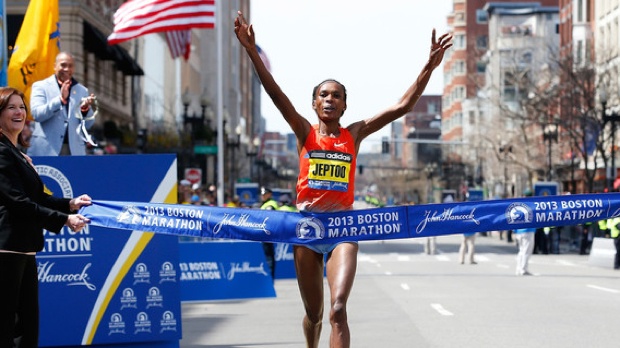
Over the weekend, the Boston Marathon and five other members from the World Marathon Majors group agreed to fund a new testing facility in East Africa to support the fight against performance-enhancing drugs.
Representatives from all six major marathon sites, including Boston, Chicago, New York, London, Berlin and Tokyo were present in a meeting in Orlando, Fla., where all agreed to financially support the facility. No official site has been chosen for the testing lab, but Nairobi, Kenya is a possibility.
Members from the World Marathon Majors are concerned due to the issue that drug tests must reach an accredited lab within 48 hours, which can be challenging in different parts of the world, especially East Africa.
Tomorrow three-time Boston Marathon winner Rita Jeptoo will appear before an anti-doping commission in Kenya to discuss her positive drug test. After winning the World Marathon Majors title, which was clinched with Boston and Chicago wins in 2014, Jeptoo’s “A” sample was found to have traces of EPO in an out-of-competition drug test conducted on Sept. 25.
A subsequent “B” sample was done in Switzerland and confirmed the positive test. Jeptoo earned $500,000 by winning the World Marathon Majors title plus a bonus of $25,000 by running a new Boston Marathon course record (2:18.57).
The World Marathon Majors has also been tainted in recent years by three-time Chicago Marathon champion Liliya Shobukhova. The Russian marathoner received a two-year doping ban in April by the Russian Athletics Federation for “abnormal hematological curves” in her biological passport, which detects fluctuations in blood chemistry over an arc of time.
In December, the Associated Press revealed that Shobukhova reportedly paid the Russian Athletics Federation $550,000 to cover up a positive doping case, and was able to compete in the 2012 Olympics despite violating doping rules in 2011 because of the cover-up.
In an attempt to combat the doping issue in Kenya, Athletics Kenya instructed agents of Kenyan athletes to provide blood profiles of their athletes on a regular basis or as when required by the medical and anti-doping commission.
AK President Isaiah Kiplagat announced the new policy along with 11 subsequent policies intended to help curb the doping issues surrounding Kenyan athletes, including an inspection of all venues to make sure anti-doping is carried out and any official or coach found in competition which has not been sanctioned by the AK will be banned.
From January 2015 on, agents are required to give AK their athlete’s blood testing report every month, and every elite athlete is required to have a biological passport that will record the movement of their blood values.