

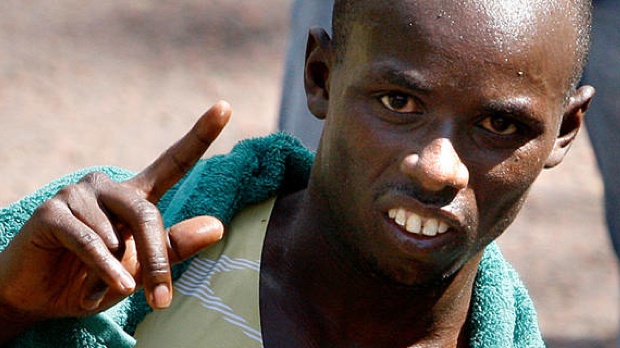
A leading Kenyan pathologist has determined that 2008 Olympic marathon champion Sammy Wanjiru’s mysterious death four years ago was in fact murder and not suicide.
According to the Daily Nation, former chief government pathologist Dr. Moses Njue ruled out a “possible suicide theory” during a court inquest into Wanjiru’s death, testifying that evidence shows the runner was attacked with a blunt metal object, the blow crushing the back of his skull and causing his brain to spill into his spinal column.
On May 15, 2011, Wanjiru fell from the second-story balcony of his posh home in the town of Nyahururu, approximately 100 miles outside of Nairobi. Wanjiru landed on the pavement, about a 16-foot drop from the balcony, and lost consciousness. He was unable to be revived and was pronounced dead that night at a local hospital.
The New York Times reported in 2011 that earlier that the evening, the 23-year-old Wanjiru was reported to have been drinking heavily and returned home with a woman named Jane Nduta. When Wanjiru’s wife, Triza Njeri, returned home and found her husband in bed with Nduta, a fight ensued and Njeri locked the couple in the bedroom, leaving them no way out.
What remains undetermined is whether Wanjiru jumped from the balcony of the bedroom or was pushed.
According to reports, Wanjiru’s body was found on a grate, which sealed with a large padlock. Early hypotheses claimed that Wanjiru hit his head on the lock and the force of that fall caused the fatal trauma.
“The fact of the matter is that Wanjiru committed suicide,” Eric Kiraithe, a national police spokesman, told the Associated Press.
According to a Reuters report, Jasper Ombati, the local police chief, said it was unclear whether Wanjiru’s death “was a suicide or if he jumped out of rage, or what caused him to fall to the ground.”
Ombati then told AP, “They got into an argument. His wife locked them in the bedroom and ran off. He then jumped from the bedroom balcony. He is not here to tell us what he was thinking when he jumped. We do not suspect foul play.”
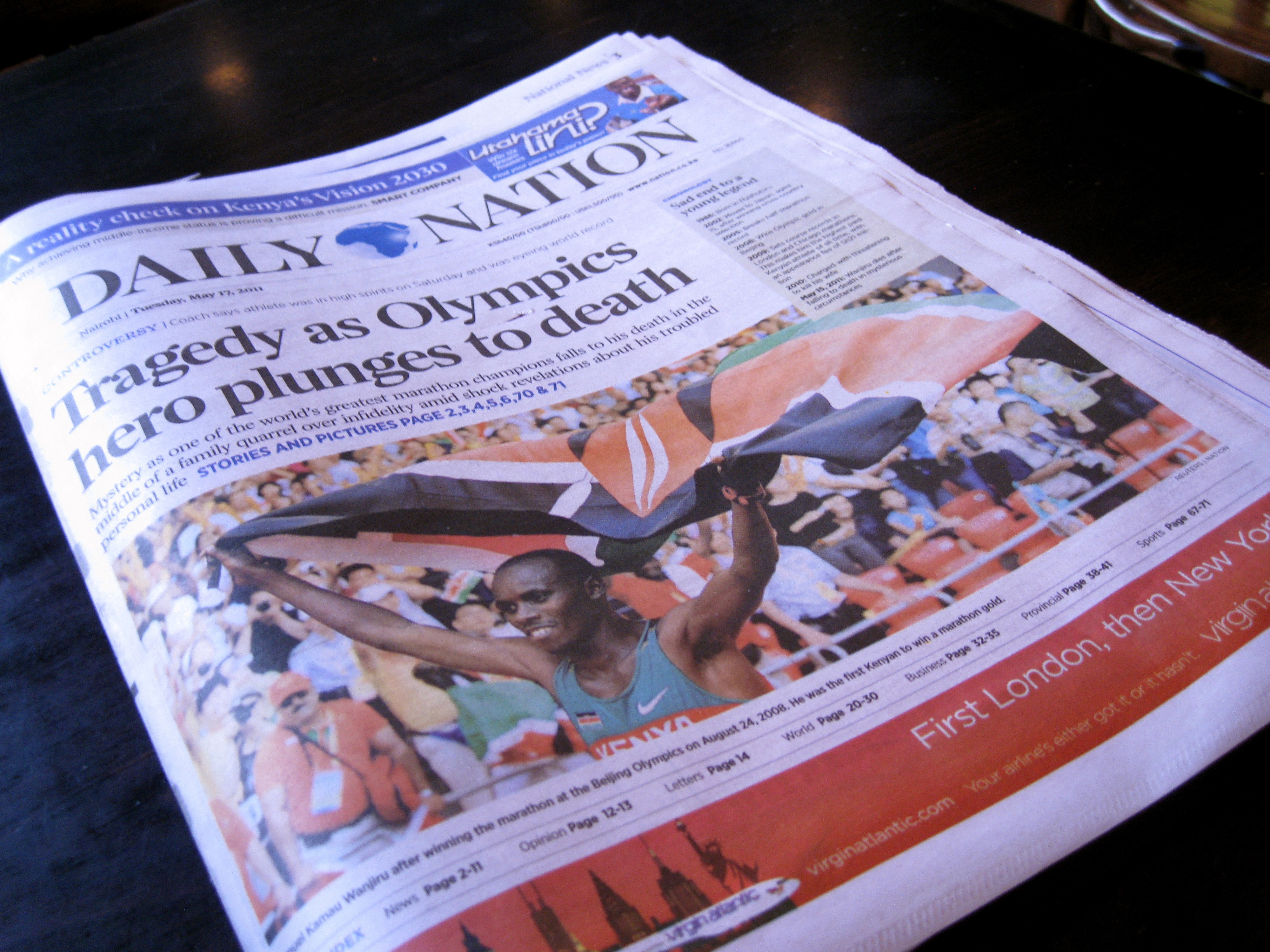
After working at Wanjiru’s home, “serious doubts and discrepancies arose” in the minds of Njue and his team of pathologists and they concluded those earlier theories to be false.
Njue said “the height from which Mr. Wanjiru fell was not enough, scientifically, to generate the momentum to kill him,” and added, “the story advanced earlier was not believable...the injuries on his head were massive and it was what caused his death, it was independently inflicted.”
Njue said that bruises and abrasions found on Wanjiru limbs indicate that he did not land on his back, but on his arms and legs, meaning the fatal wound to his head was delivered later.
According to the Daily Nation, Njue testified that an examination of Wanjiru’s corpse revealed “a patterned abrasion on the left cheek with three visible parallel lines,” and “an abrasion below the left eye but what drew our attention was the swelling at the back of his head.”
The fracture to Wanjiru’s skull split into two lines from its base, extending longer to the left side. Such an impact, according to Njue, would have rendered him paralyzed instantly, meaning he would have been attacked immediately after landing from the balcony.
“The cause of death can be said to be a massive blunt object force injury to the back of the head with resultant skull fracture, attendant haemorrhage...there was also significantly raised intracranial pressure and brain contusion,” Njue said.
According to Njue, an individual, even intoxicated, would have had to fall from 30 feet or more for the impact to result in an injury such as he found in his post-mortem examination of Wanjiru.
“He was a soldier and an astute athlete and very agile...he actually landed on his four limbs cat-style and the fatal head injury was inflicted independently,” Njue said.