
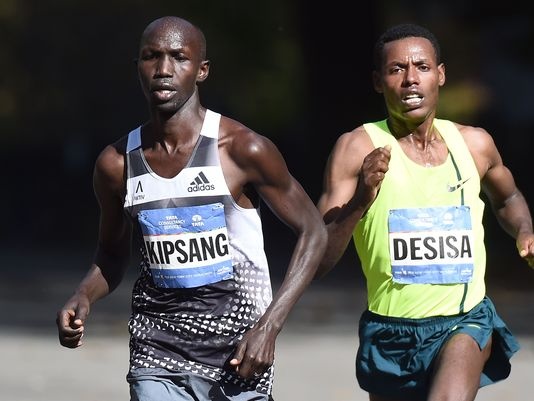
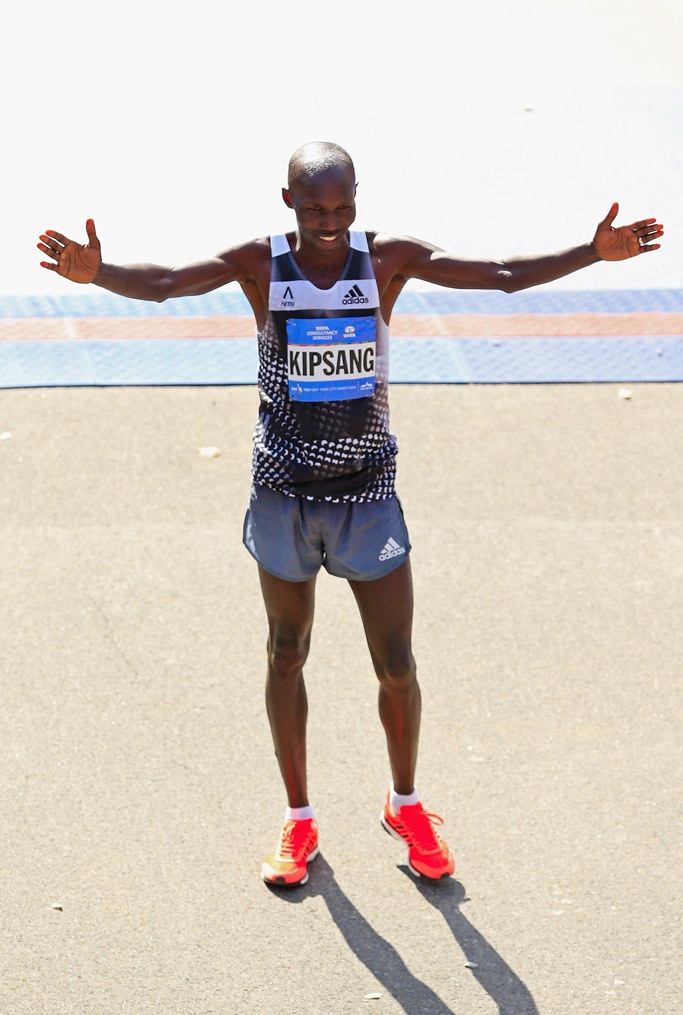
NEW YORK – Kenya’s Wilson Kipsang will be the man to beat once again on Sunday when he attempts to capture a second consecutive TCS New York City Marathon title.
The 33-year-old, who has run more sub-2:05 marathons (six) than any other athlete in history, spoke at length during today’s media roundtable about his preparations for the race, and the ill-conceived proposal to hold Kenyan marathon Trials ahead of the Rio Olympics. Below are the highlights from that interview.
How would you categorize your condition this year compared with last year?
I think, when I compare my condition last year and this year, I think this year I feel well prepared. I think I can run faster than last year.
 Did you do anything different in your training to prepare for the race this year than you did last year?
 I think last year it was my first time. So I had not really known how the course would be. This year I really knew how the course was, and I prepared very well, training for the course and doing much endurance and lots of speed.
Having done the World Championships, there's an extra marathon this year for you. You went 35K before you dropped out in Beijing, but how have you managed the change of an extra marathon?
I think, for me, if I try to look at the preparation for the World Championships, having not completed the race, I just counted it as a long run. If you try to see the speed of that 35 kilometers, it was just like a long run in training. So I just went and recovered a little bit and then proceeded to train. So it's like I've been training all the way through for this race.
What kind of speed work did you do for this race?
Much of the speed work I did for this race is Fartlek, which is mostly downhill and uphill and also the track sessions, more of the 1000m sessions.
How many 1000m sessions did you do?
Like 10, sometimes 12.
You said you did your Fartlek work up and downhill, was that specifically for the end of this race?
Yeah, specifically for the end of this race.
Where did you do these runs?
I did some in Iten, some in Marakwet, some in Kaptagat.
Do you think the course record is within your sights on Sunday?
It depends how the weather will be and how guys will cooperate. In weather like this, there are no problems. If guys cooperate, we'll have a good time.
What did you learn about yourself as a runner last year winning in those difficult, windy conditions?
What I learned mostly about last year's race is that you are fully prepared for the race. I saw the potential to win a very difficult race because last year was very difficult, very windy. Nobody wanted to push. I saw that I really prepared myself very well, and I was able to pick up the pace towards the end.
Is there any part of the course that you want to improve on that you trained for specifically in any particular part of the course?
I think this course it's easier to understand. So you have to make sure that you run fast at the start, but you make sure you save more energy for the last part.
For a race like this with a course that's the hills and different types of road, how much will it help that now you've run this course now a second time?
I think, when you run a race, when it's in your memory, it's very easy to run the second time because every session you can remember this is how it is. This is how it is. This type of hill is not very far. It's not high. Maybe we still have some hills remaining. It's in your mind because you want to save your energy to prepare, try to speed up so much, and you try to, if you know this is the last one, maybe you try now to break off from there.
The one person we haven't seen in the marathons much this year is Geoffrey Kamworor. He's a World Half Marathon champion, a World Cross-Country champion and a silver medalist in the 10,000m Worlds. What kind of race do you think he'll run? Is he a guy that, if you meet him in the closing stages, he'll be a fast finisher?
Geoffrey Kamworor, he ran the marathon, and then it wasn't going well for him, and then he came back to half marathon and maybe the 10,000m. So I think for now when he decided to come back again, it will be tough -- how he prepared himself will determine how he performs in the marathon, how he's ready to approach the marathon mentally.
Does a guy with his kind of track speed worry you late in the race? You sort of ran up against that in London with Kipchoge. He had a little bit more at the end. Does that sort of track speed worry you?
For me, I think it doesn't worry me so much because I really believe that with my training I have that kind of speed. It depends now if he's prepared himself very well. You cannot compare Kipchoge and Geoffrey Kamworor.
Recently, Athletics Kenya tried to change the qualifying procedure for the Olympics by holding a marathon Trials in February. This week, they canceled the Trials. Are you happy with that?
I think they tried to say that maybe the trial won't work. If you run fast, and maybe they can select it from there.
If the Trials were in February, would you have run for that?
I wouldn't run because I have a marathon to run maybe. If those guys are running in Tokyo, it will be very close. Those who will be running in the spring marathons, it wouldn't have been convenient to run more than two months.
So you would have chosen a spring marathon over the Trials?
Yes.
So you wouldn't have gone to the Olympics?
Yes.
Are you looking forward to Rio? Is the gold medal still your goal?
Yeah, of course. In London I got a bronze, and I'm really looking forward to maybe go for the gold because Olympics is one of the biggest events. I would love to go compete and get a medal.
Do you feel like dropping out at 35K at the World Championships is going to hurt your chances being selected for the Olympic team given the politics and the ambiguous selection process of AK?
I think somebody like me I don't have much pressure. Whether I'm with the team or not, I will still have races to run.
How do you think, when the Federation decides to pick the Olympic team, what do you think they should consider? There's so many different ways they can make that decision.
For now, I think it's too hard. From this year to next year, they'll try to have a way of doing the selection. But if you try to see the marathon it's very important for our selection to be done. It's very hard.
Maybe in February they should be selecting. So that when you're running in April, you know I'm on the team. So you know how to run in the next race and try to prepare. But if you are confirmed late, it's not really very good because, to prepare mentally, time will catch up.
If for some reason they said, Wilson Kipsang, you're the head of competition for AK, and you got to make the rule on how the selection would go for the marathon, what would be your advice? How would you do it if you were in charge?
My advice is I would try to list a number of athletes who are potential, like ten of them. Invite them in a meeting, talk to them personally, each and every one. What they see to represent their country. Then we have to be in full consensus, and then the athletes who are not confirmed should be ready to assist the others.
So by February they should be confirmed so you're fully informed you will be running. Know that we are there, and you will be representing the country. And then also the Federation can offer support as early as possible when it comes to training, logistics, about the weather conditions, try to do that and assist them to go to training places where they can really assist them to perform very well.
Would that be contingent on anything that happens-- if you make the choices in February and let's say somebody had a bad race in April, it wouldn't really affect it?
Of course, because in a marathon you might find you run poorly this time and the next time you run good. It's not an indication, if you run well in February, you're going to run well in August. No. Many times in training for marathons, you can run good. Somebody might run a bad race, but with full training, organized, good program, you can find by race time you can run very well.
WATCH: Driven - Wilson Kipsang (Ep. 1)
WATCH: Driven - Wilson Kipsang (Ep. 2)