After Portland Slump, Rejuvenated Souleiman Targets Olympic Gold
After Portland Slump, Rejuvenated Souleiman Targets Olympic Gold
By Elshadai NegashAt first, there wasn't anything remarkable about the Kempinski Hotel along the Red Sea in Djibouti. The reception area held its typical cr
By Elshadai Negash
At first, there wasn't anything remarkable about the Kempinski Hotel along the Red Sea in Djibouti. The reception area held its typical crowd of businessmen, lightly suited bureaucrats and other harried travelers who chatted amongst themselves while the hotel staff tended to their needs.
But suddenly, the atmosphere changed. Conversations came to a halt as travelers looked up from their screens.
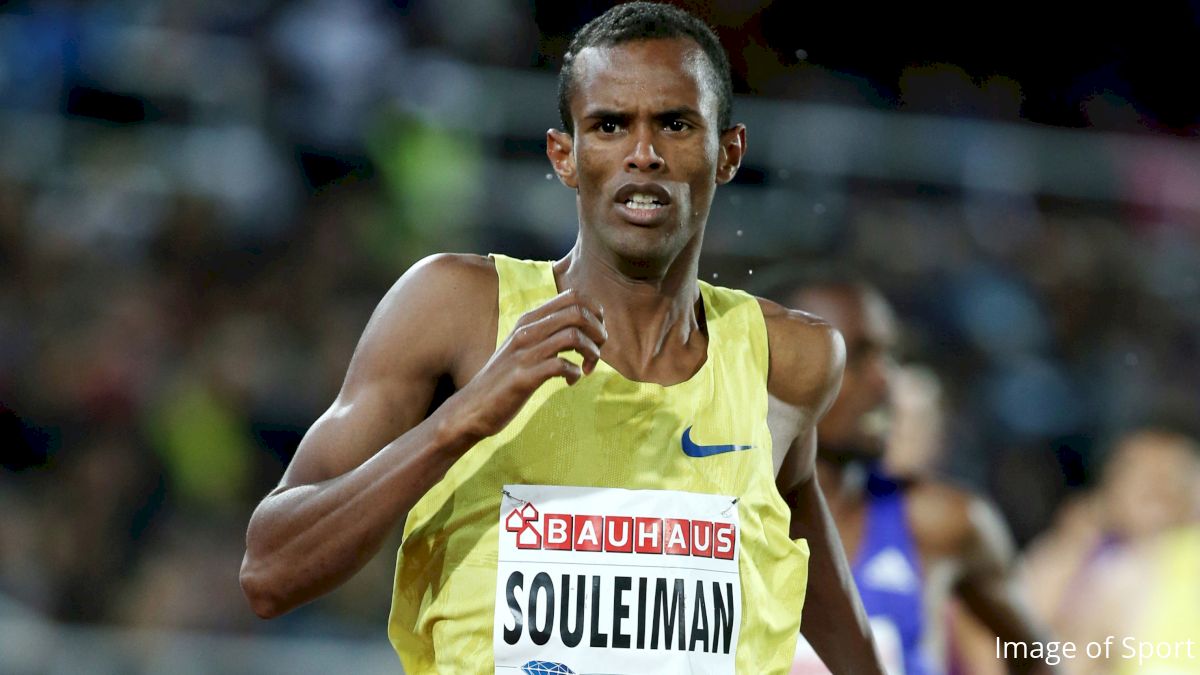
They were distracted by a group of slender-looking athletes who just walked in, but one of them particularly drew their attention: Ayanleh Souleiman, indoor world-record holder in the 1000m.
In a matter of minutes, the selfie frenzy began, replete with hugs and kisses as Souleiman politely smiled for the cameras and waded through the crowd to meet his coach in the hotel.
“He understands what he means to the people of Djibouti,” Jama Aden, Souleiman's coach, said.
With the 2016 Olympic Games approaching, the nation's eyes are fixed on Souleiman, who recently improved his resume in February with an indoor world record of 2:14.2 over 1000m in Stockholm, Sweden. Later, at the IAAF World Indoor Championships in March, the defending 1500m champion struggled to ninth due to illness. Now, he's out to prove to his fans and the world that he's a serious contender for gold in Rio.
Souleiman, who spends much of the year away from his homeland to train in Ethiopia, Spain, and Sweden, returned to Djibouti this month to promote and compete in the first-ever international track and field meet on these shores.
“This is the first time I am competing in Djibouti since 2010,” the 23-year-old Souleiman said. “Every time I return to Djibouti on vacation, people stop me on the streets and ask when they will see me run in my own country. Today, I am very happy to fulfill their wishes.”
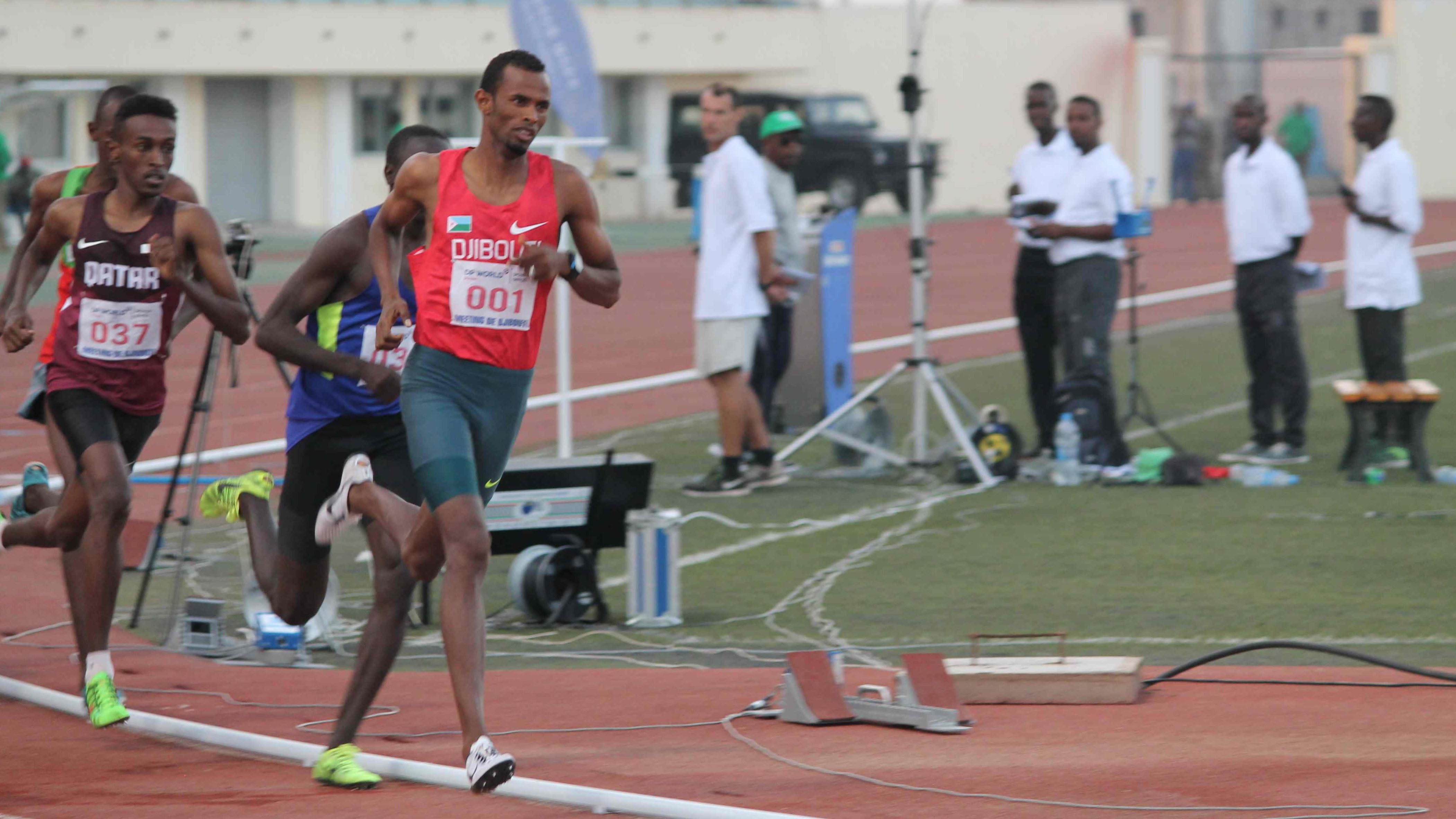
At the Meeting De Djibouti, Souleiman dominated the 1000m field with a breezy 2:21.65. As he neared the finish line, he saluted his boisterous hometown crowd, which included the country’s president, Ismael Gouleh -- one of his biggest supporters. After his victory lap, the delighted Souleiman took the microphone to thank the spectators, his club, Djibouti Police, and the president for their support.
Fast Start to the Year
Back at the hotel, Souleiman recounted how things were much different 10 days earlier at the Oregon Convention Center in Portland. “I had a chest infection during my preparation, and I was fatigued in Portland,” he said after his ill-fated world indoor 1500m title attempt. “I finished ninth, which was not the best reflection of my shape this season.”
As they did in the previous three years, Souleiman and a group led by Coach Aden camped in Sululta on the outskirts of the Ethiopian capital Addis Ababa for their warm-weather altitude training camp. Souleiman started the season in scintillating form, taking victories in Birmingham and Glasgow before breaking Denmark’s Wilson Kipketer’s 16-year-old world indoor 1000m record at the Global Galan in Stockholm, Sweden.
Despite his disappointing loss in Portland, Souleiman remains upbeat, and said he's learning how to take defeats in his stride: “Of course, it did not feel good to lose. I smiled, congratulated the winner [American Matthew Centrowitz] and have tried to move away from the bad experience.”
Doping Scrutiny
Due to recent doping headlines, Souleiman knows that he and other elites are now highly scrutinized. After several busts, including Sweden’s 2013 world champion Abeba Aregawi and Olympic silver medallist Gamze Bulut, track and field has been in the spotlight lately for the wrong reasons.
“Whenever I hear that someone in our field tested positive, I get shocked because I have known these athletes for a few years in meetings,” he says. “It just means that we have to be extra careful about everything. I know, for example, I cannot just go the pharmacy and buy [over-the-counter] medicine like a regular person when I get sick. For example, when I had the chest problems, I did not take any medicine and just allowed to it to heal naturally because I was afraid of taking medicine.”
Souleiman likely won't need a reminder of how stringent doping control has become -- he was tested five times between January and March of 2016. “I read in the newspapers that doping control is not strong in Ethiopia, but on training camp before Portland, I got tested five times [since the turn of the year],” he says. “I got tested more in Ethiopia than anywhere else in my life. I am a clean athlete and have nothing to fear by this. It would be fair to sometimes know what actually happens before assuming things.”
Olympic Ambitions
But Souleiman understands that doping tests and public scrutiny are small sacrifices to pay ahead of a big year for the sport with the 2016 Olympic Games just four months away. Backed by a reputation on the track as fighter who takes races from the front, his coach admits it will take more than one tactic to triumph in the Brazilian capital.
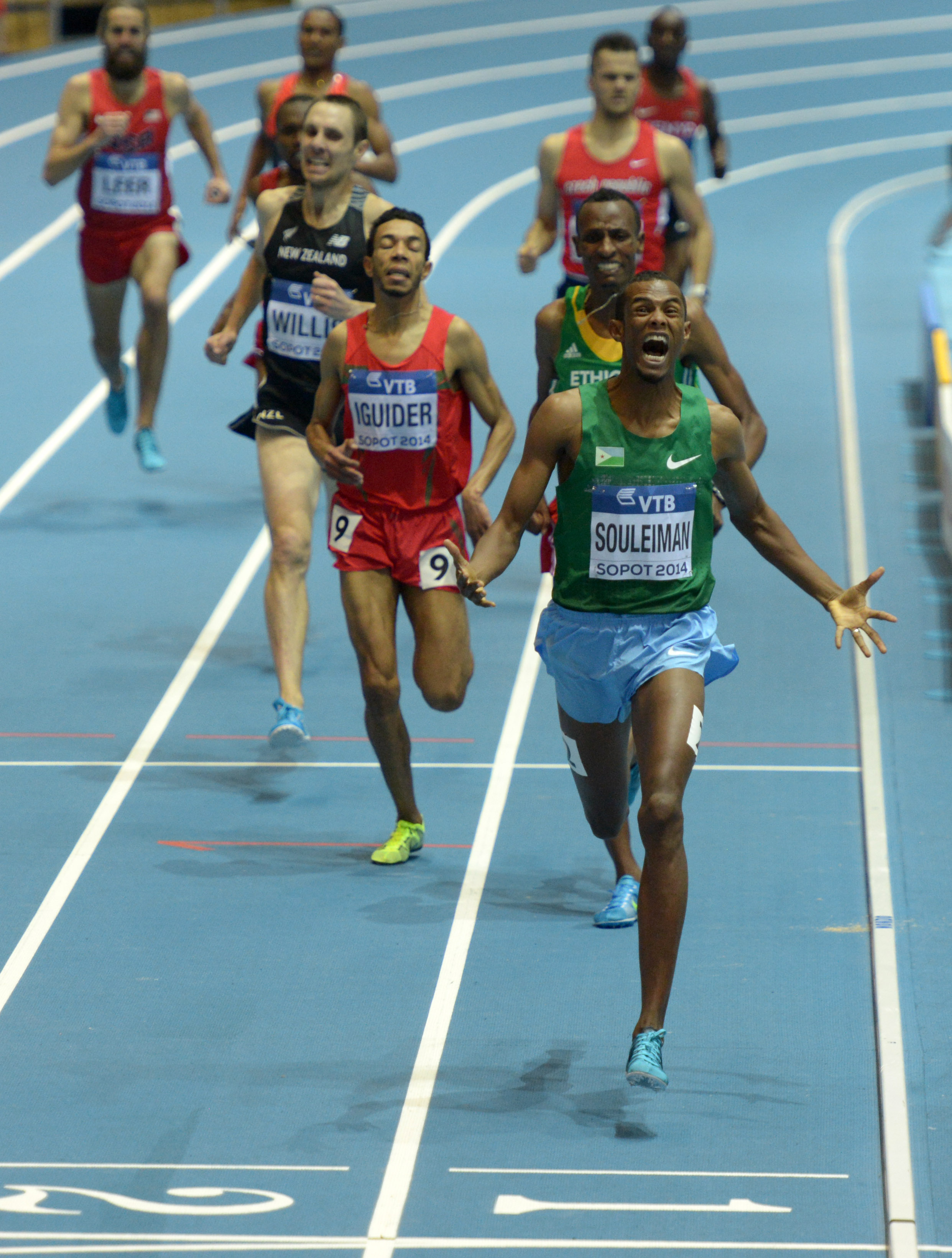
“Souleiman is a fighter, and is used to winning through fighting from the front,” says Aden, who masterminded Genzebe Dibaba’s mind-boggling 1:56 for the last 800m of her 1500m victory at the world championships in Beijing. “This year, we will work better on different tactics. Souleiman is also gaining experience and will also need to run with his mind.”
He will run for a country with a credible track and field history, but only Hassen Ahmed Saleh’s Olympic bronze medal in the marathon at the 1988 Games in Seoul to show for it.
As he wound down from victory at the Stade Gouled in front of his home supporters, Souleiman smiled at the very thought of personally bringing home an Olympic medal. "That would be big for me and Djibouti. We are a country on the rise in athletics. It will take us even higher.”
The pride of his people and the hero of a small nation, Souleiman will look to run with their smiles and cheers to victory in Rio.
In his own words:
- "I don’t smile all the time. People always see me smiling, and that's what I show in public after winning or losing. I show in public that I am not disappointed (after a loss), but there is a fire in my heart. It comes out whenever I lose a race. I cannot sleep for days after defeat."
- "When I am on holidays, I completely block out athletics. I enjoy my music and have fun with friends on the beach."
- "I have been lucky to make a good living from athletics, but I have not forgotten the less fortunate who don’t have the resources like myself. I support about 14 students through school in Djibouti, Somaliland and Ethiopia."
- "Whenever I am in Dubai, I go speed-racing at night with friends or other athletes. This is against the advice of my coach, but I tell him where I was after the fact."
- "I have a natural affinity for things that are fast. On the beach with my boys, we go take our motorbikes and roar up the place. The roar of the engine and showboating my skills gives me chills."
At first, there wasn't anything remarkable about the Kempinski Hotel along the Red Sea in Djibouti. The reception area held its typical crowd of businessmen, lightly suited bureaucrats and other harried travelers who chatted amongst themselves while the hotel staff tended to their needs.
But suddenly, the atmosphere changed. Conversations came to a halt as travelers looked up from their screens.
They were distracted by a group of slender-looking athletes who just walked in, but one of them particularly drew their attention: Ayanleh Souleiman, indoor world-record holder in the 1000m.
In a matter of minutes, the selfie frenzy began, replete with hugs and kisses as Souleiman politely smiled for the cameras and waded through the crowd to meet his coach in the hotel.
“He understands what he means to the people of Djibouti,” Jama Aden, Souleiman's coach, said.
With the 2016 Olympic Games approaching, the nation's eyes are fixed on Souleiman, who recently improved his resume in February with an indoor world record of 2:14.2 over 1000m in Stockholm, Sweden. Later, at the IAAF World Indoor Championships in March, the defending 1500m champion struggled to ninth due to illness. Now, he's out to prove to his fans and the world that he's a serious contender for gold in Rio.
Souleiman, who spends much of the year away from his homeland to train in Ethiopia, Spain, and Sweden, returned to Djibouti this month to promote and compete in the first-ever international track and field meet on these shores.
“This is the first time I am competing in Djibouti since 2010,” the 23-year-old Souleiman said. “Every time I return to Djibouti on vacation, people stop me on the streets and ask when they will see me run in my own country. Today, I am very happy to fulfill their wishes.”
At the Meeting De Djibouti, Souleiman dominated the 1000m field with a breezy 2:21.65. As he neared the finish line, he saluted his boisterous hometown crowd, which included the country’s president, Ismael Gouleh -- one of his biggest supporters. After his victory lap, the delighted Souleiman took the microphone to thank the spectators, his club, Djibouti Police, and the president for their support.
Fast Start to the Year
Back at the hotel, Souleiman recounted how things were much different 10 days earlier at the Oregon Convention Center in Portland. “I had a chest infection during my preparation, and I was fatigued in Portland,” he said after his ill-fated world indoor 1500m title attempt. “I finished ninth, which was not the best reflection of my shape this season.”
As they did in the previous three years, Souleiman and a group led by Coach Aden camped in Sululta on the outskirts of the Ethiopian capital Addis Ababa for their warm-weather altitude training camp. Souleiman started the season in scintillating form, taking victories in Birmingham and Glasgow before breaking Denmark’s Wilson Kipketer’s 16-year-old world indoor 1000m record at the Global Galan in Stockholm, Sweden.
Despite his disappointing loss in Portland, Souleiman remains upbeat, and said he's learning how to take defeats in his stride: “Of course, it did not feel good to lose. I smiled, congratulated the winner [American Matthew Centrowitz] and have tried to move away from the bad experience.”
Doping Scrutiny
Due to recent doping headlines, Souleiman knows that he and other elites are now highly scrutinized. After several busts, including Sweden’s 2013 world champion Abeba Aregawi and Olympic silver medallist Gamze Bulut, track and field has been in the spotlight lately for the wrong reasons.
“Whenever I hear that someone in our field tested positive, I get shocked because I have known these athletes for a few years in meetings,” he says. “It just means that we have to be extra careful about everything. I know, for example, I cannot just go the pharmacy and buy [over-the-counter] medicine like a regular person when I get sick. For example, when I had the chest problems, I did not take any medicine and just allowed to it to heal naturally because I was afraid of taking medicine.”
Souleiman likely won't need a reminder of how stringent doping control has become -- he was tested five times between January and March of 2016. “I read in the newspapers that doping control is not strong in Ethiopia, but on training camp before Portland, I got tested five times [since the turn of the year],” he says. “I got tested more in Ethiopia than anywhere else in my life. I am a clean athlete and have nothing to fear by this. It would be fair to sometimes know what actually happens before assuming things.”
Olympic Ambitions
But Souleiman understands that doping tests and public scrutiny are small sacrifices to pay ahead of a big year for the sport with the 2016 Olympic Games just four months away. Backed by a reputation on the track as fighter who takes races from the front, his coach admits it will take more than one tactic to triumph in the Brazilian capital.
“Souleiman is a fighter, and is used to winning through fighting from the front,” says Aden, who masterminded Genzebe Dibaba’s mind-boggling 1:56 for the last 800m of her 1500m victory at the world championships in Beijing. “This year, we will work better on different tactics. Souleiman is also gaining experience and will also need to run with his mind.”
He will run for a country with a credible track and field history, but only Hassen Ahmed Saleh’s Olympic bronze medal in the marathon at the 1988 Games in Seoul to show for it.
As he wound down from victory at the Stade Gouled in front of his home supporters, Souleiman smiled at the very thought of personally bringing home an Olympic medal. "That would be big for me and Djibouti. We are a country on the rise in athletics. It will take us even higher.”
The pride of his people and the hero of a small nation, Souleiman will look to run with their smiles and cheers to victory in Rio.
In his own words:
- "I don’t smile all the time. People always see me smiling, and that's what I show in public after winning or losing. I show in public that I am not disappointed (after a loss), but there is a fire in my heart. It comes out whenever I lose a race. I cannot sleep for days after defeat."
- "When I am on holidays, I completely block out athletics. I enjoy my music and have fun with friends on the beach."
- "I have been lucky to make a good living from athletics, but I have not forgotten the less fortunate who don’t have the resources like myself. I support about 14 students through school in Djibouti, Somaliland and Ethiopia."
- "Whenever I am in Dubai, I go speed-racing at night with friends or other athletes. This is against the advice of my coach, but I tell him where I was after the fact."
- "I have a natural affinity for things that are fast. On the beach with my boys, we go take our motorbikes and roar up the place. The roar of the engine and showboating my skills gives me chills."