Moneyball In The NCAA: How Georgia Quickly Rose To The Top
Moneyball In The NCAA: How Georgia Quickly Rose To The Top
No other team is built like Petros Kyprianou's Georgia Bulldogs, and that's exactly why they had the best overall NCAA program in 2018.
Unlock this article, live events, and more with a subscription!
Already a subscriber? Log In
When Georgia track and field head coach Petros Kyprianou first began his collegiate coaching career in the U.S. 15 years ago as an assistant at the University of Nebraska Omaha, recruiting talent to the Division II program was often a rudimentary and utilitarian process.
Kyprianou wasn’t afforded the resources to attract athletes from across the country, so he honed in on the most practical location available to him then: the school’s campus. These recruiting trips were not at all sophisticated; like a beach-goer combing the sand for lost coins, Kyprianou was unlikely to find hidden athletic treasures simply by scouring the student-body as they moved from class to class. Plus, the coach was at risk of coming off like a creep as he diligently scanned people who didn’t know they were being analyzed.
But the former decathlete from the tiny mediterranean island of Cyprus had a method to his madness. A Bulgarian coach named Vasiliy Krumov, whom Kyprianou studied under in Europe, had taught him to detect simple performance indicators just from observing someone walking-- like how the achilles tendon contracts with a calf muscle-- a practice that Krumov used to predict track and field potential with surprising accuracy.
‘“He would like give me a dissertation. ‘Ok, this guy can long jump this far.’ And one out of three times he was right,” Kyprianou said.
Applied in Nebraska, the acute attention to detail learned from Krumov helped net Kyprianou a future NCAA DII long jump champion from off the street. His development of that diamond in the rough find not only flashed his keen eye for talent and technical acumen, but also his midas touch for quickly assembling a viable track team from scratch.
In just his third and final year in Omaha in 2005, Kyprianou’s reputation as a field event whisperer was starting to make waves in the U.S. The UNO women’s team-- led by that long jump champion and another in the triple jump-- finished fifth at NCAA indoor to record their best finish in school history. The Mavs had placed 22nd the year before.
Today, Kyprianou is well-removed from on-campus scouting trips in his fourth year as the men’s and women’s head coach at the University of Georgia, as he is now regarded as one of the top field event and multis coaches in the world. But what hasn’t changed from those far gone Nebraska Omaha days is his special ability to squeeze out the most of his athletes and his MO for crafting a nationally-competitive program that resembles no other team in the NCAA.
Since 2014, when Kyprianou was promoted to the associate head coach role, Georgia has amassed 29 individual NCAA titles, with 28 of them coming from either field events or the multis. As their competitors have continued to take a traditional approach to building championship rosters-- focusing on the relays, recruiting athletes to compete in the marquee sprint and distance events where points are harder to come by-- Georgia has thrived by cornering the NCAA market in their speciality, an area of U.S. collegiate track that happens to be far less competitive relative to the premier track events like the 100m and 400m.
For Kyprianou, that strategy was born not only from his coaching expertise but also from his early realization that he could do more with less in the field events. Constructing a competitive 4x400m relay may be fun and exciting, but it is also incredibly costly to have four athletes on full-ride scholarships with just 10 points on the line. His logic goes that it’s much more efficient to recruit multiple decathletes who could eventually combine to score 18 points.
Not unlike the early 2000s Oakland A’s baseball team of Moneyball fame, who thrived by finding cheap and efficient players with particular skills-- like high on-base percentage-- that most of baseball didn’t value as much as outdated stats such as batting average, Georgia has exploited a market inefficiency in collegiate track with resounding success.
“My main thing was trying to be efficient in events that were a little weaker,” he said.
“I remember years where 7800 points would win the decathlon at the NCAAs. I was like, ‘Wow.’ Not that it’s easy to score 7800 points, but it’s a lot easier to score 7800 than to run a 3:35 in the 1,500m, you know. Or run 9.9 in the 100 meters to win it. 10 points is 10 points. So I try to kind of go that route, and in a way I got a little lucky with some good athletes.”
That approach has led to a remarkable turnaround in Athens. When Kyprianou was promoted to the head coaching gig after the 2015 season, he boldly told Georgia athletic director Greg McGarity that he planned to lead the Bulldogs to a national title within three years. The comment generated some laughs from those around the program, and despite McGarity’s strong belief in his new coach, he cautioned Kyprianou to be realistic. The Georgia women had just finished fifth at NCAA outdoors a month earlier, and the men had placed a distant 15th.
“I remember he (McGarity) said winning is a marathon not a sprint,” said Kyprianou. “And I said, ‘Not necessarily.’ If you have the right athletes and the right coaches it can be a sprint. And then it can be a long sprint. It can be a 800 meters and you can keep running.”
After a few years of dominating the NCAA in their niche without reaching the top of the team podium, the Bulldogs finally broke through in 2018 with NCAA team titles indoors for the women and outdoor with the men, both firsts in program history. Kyprianou had delivered on his seemingly idealistic three-year outlook. In a season where individual events like the 200m and 400m exploded-- it took collegiate records to win those events for both genders at indoor nationals in 2018, and again outdoors in the men’s 400m-- Kyprianou’s championship teams won by gobbling up more accessible points.
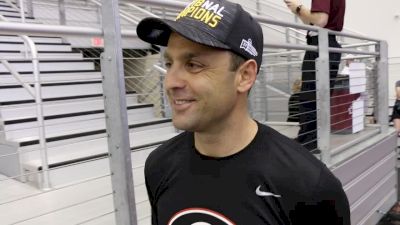
Kyprianou after winning his first national title at the 2018 NCAA Indoor Championships:
Of course, Kyprianou has developed his share of NCAA greats in the field events, too. After an unparalleled four-year career in which she swept the outdoor triple jump all four years and won three triple jump indoor crowns, Keturah Orji was awarded the Bowerman Trophy in December as NCAA track and field’s top athlete. She owns the top eight indoor triple jump marks in NCAA history and the American record.
Nonetheless, the coach’s path to the top has no doubt been made easier with a focus on events that are not currently being dominated by athletes re-writing the collegiate record books at the same rate as others.
The stats back up the approach. During the last two indoor and outdoor NCAA track seasons, a whopping 73-percent of the top performances in each of the sprint, distance and hurdle events for both genders were either a collegiate record or a top-two all-time performance. Think about that. That means that nearly three out of four NCAA-leading times in the last two seasons have been either the best-ever or second-best in history.
So how did the field events measure up in that same window? Just 28-percent of the top marks in 2017 and 2018 were that high up on the all-time list. If track and field strategy is an art, Petros Kyprianou is its Picasso.
Consider that in the women’s indoor long jump (24 points) and men’s decathlon (14 points), the two events in which each of Georgia’s title-winning teams scored the most points, not one of their athletes recorded a top-10 all-time mark in doing so.
That’s precisely why Kyprianou scoffs at the notion that his second-place women’s outdoor team last year lost NCAAs because of their lack of a 4x400m relay. The Bulldogs were beaten by one point by USC after the Trojans famously pulled off a miraculous comeback to win the final event, ripping the trophy from Georgia’s hands as they helplessly watched a 4x400m champ surpass them in the final event for the second straight year. But two consecutive dramatic losses at outdoor nationals isn’t going to set Kyprianou on the hunt for a flashy 4x400m squad; he knows that points were left on the table in earlier events that had much more to do with their outcome than any USC heroics.
Kyprianou has heard the noise, but he’s sticking to his guns.
“The 4x4, because that was the only thing they were showing, they didn’t show any field events, and they were like, ‘Oh man, if you guys had a 4x4!’ he said.
“They’re all geniuses and wanted to give me advice about how to put together a 4x4. And I said, ‘No, no, no. Guys, you don’t understand.' We shot ourselves in the foot in the long jump and the high jump. We still came up short by [just] one point. We really messed up in the long jump. Kate Hall should’ve got a 10. Tatiana Gusin should’ve got 10 [in the high jump], and we still lost by one.”
Kyprianou’s laser-focus on efficiency extends well past moving his chess pieces around the NCAA board. A big part of every recruiting visit the coach takes is a questionnaire that his sister, who holds a PhD. in sociology, helped him to develop. From each recruit’s answers to the 20 questions, a linear regression analysis is used to map the athlete’s mental strength and their fit within Kyprianou’s program.
He acknowledges that the evaluation is by no means a perfect science, and that the analysis can’t always tell the full story. Certain athletes are able to game the system by answering with what they know the coach wants to hear. However, the questionnaire is a tool that Kyprianou leans on heavily as a means of helping him determine which athletes are likely to continue to progress in college and which ones may not pan out; Kyprianou says he’s passed on at least 10 recruits at Georgia based on how they performed in the mental evaluation.
“In some of the events that I personally coach, I have to turn them down and it was bad. We’ve had a 22-foot long jumper that we didn’t even bother,” he said.
But to label the former decathlete from Cyprus as just a numbers-obsessed niche specialist who has quickly ascended in an era where field events have lagged in the NCAA is to unfairly pigeonhole the fast-rising superstar coach. After all, one of Kyprianou’s top athletes last year was freshman sprint sensation Lynna Irby, who won the 400m NCAA title in 49.80, the second-fastest collegiate performance ever. Georgia will continue to be a field event-heavy program so long as Kyprianou is at the helm, but last year’s successes from Irby in the sprints and Jessica Drop in the distance events highlight a program that may soon be as balanced as any in the nation.
That would be just fine for the constantly-tinkering coach, who is always looking for innovative ways to make his team better. Two years ago while recruiting Irby to the program, he promised the sprinter that he would ride his motorcycle around the Georgia outdoor track if she signed. When she did eventually pick the Bulldogs, Kyprianou kept his promise and ripped around the track at exactly Irby’s PR at the time.
What was once a one-off thing for Irby has become something of an annual tradition in the years that have followed; Kyprianou can now routinely be seen jumping his dirt bike while wearing a Georgia cape to celebrate the latest recruit signing.
When you receive great news...you jump FAR for joy!!! #godawgs #findyourgreatness pic.twitter.com/GhNUstbrB1
— Petros Kyprianou (@petrosdeca) November 7, 2018
“The funny thing is my AD’s office oversees the track,” said Kyprianou. “I didn’t tell them anything [before Irby signed] so he was like, ‘What the hell is he doing on the track?’ But now he knows and he applauds that actually.”