Day 7 Grades: Naser Tops Miller-Uibo In 400m All-Timer
Day 7 Grades: Naser Tops Miller-Uibo In 400m All-Timer
Salwa Eid Naser, Shaunae Miller-Uibo, and the U.S. women's 1500m earned high marks on Thursday in Doha.
Unlock this article, live events, and more with a subscription!
Already a subscriber? Log In
A 400m women's race for the ages, a fifth-place finish turning into a bronze medal, and all three Americans qualifying for the women's 1500m final were the highlights on day 7 in Doha.
Here are the grades:
Salwa Eid Naser and Shaunae Miller-Uibo: A+
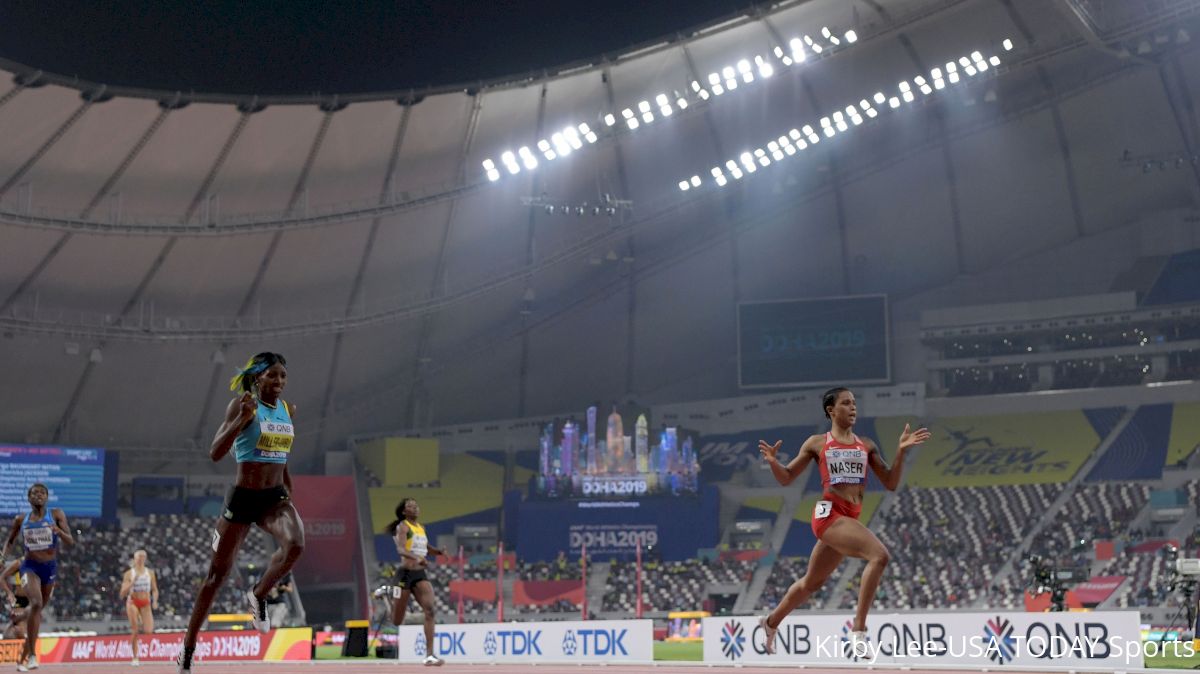
It wasn’t quite a world record, but Salwa Eid Naser’s 48.14 upset of Shaunae Miller-Uibo in the women’s 400m might as well have been. The matchup that we had waited over a year to witness produced a pair of times not seen in the event for decades.
“She really brings out the best in me,” Naser said of Miller-Uibo.
It's hard to argue with the results.
At the age of 21, Salwa Eid Naser becomes third fastest female 400m runner in history on her way to #WorldAthleticsChamps ? in 48.14.
— IAAF (@iaaforg) October 3, 2019
?: https://t.co/QyBEEO2SS4 pic.twitter.com/0iQOp6IfOl
The 21-year-old from Bahrain erased the stagger between her and Miller-Uibo at halfway, and proceeded to pummel the 2016 Olympic champion over the next 100m. Naser’s 23.00 split between 100m and 300m ensured she wouldn’t be caught by the 21.74 200m runner. 48.14 is the third-fastest ever and the quickest since the world record was set 34 years ago.
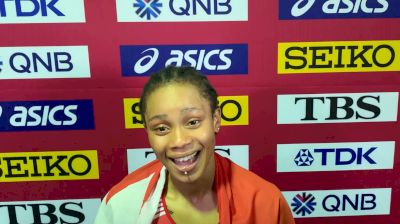
“Crazy…I was not expecting such a fast time,” said Naser.
Miller-Uibo rallied in the final 100m, but it wasn’t nearly enough. She settled for silver in 48.37, the 10th-fastest ever.
Lance Brauman, Miller-Uibo’s coach, said she executed by design.
“Ran the race she was supposed to run,” he said. “It just wasn’t good enough.”
The only women ahead of Naser all-time — Marita Koch (47.60) and Jarmila Kratochvílová (47.99) — have long been suspected of doing so with the help of performance-enhancing drugs. Both women competed in the 1980s, an era considered to be rampant with performance-enhancing drugs.
But of course, no one knows for sure that both women were doped. The lack of certainty puts today’s athletes in an awkward position.
Asked if she thought her time tonight was the true record, Naser played coy: “You tell me.”
Before tonight, France’s Marie-José Pérec (48.25) was the only non-Eastern Bloc woman to run within a second of Koch’s world record. On Thursday, both Naser and Miller-Uibo did as much. The PBs were massive for each: Naser lowered hers by 0.94 seconds and Miller-Uibo 0.60.
When Brauman saw the splits on a monitor, he stopped to take a photo with his phone.
400 splits (rounded up tenth)
— PJ Vazel (@pjvazel) October 3, 2019
Salwa Eid Naser ??
12.1 - 23.2 - 35.1 - 48.14
12.1 + 11.1 + 11.9 + 13.1 (+25.0)@Hey_ItsShaunae ??
12.1 - 23.6 - 35.7 - 48.37
12.1 + 11.5 + 12.1 + 12.7 (+24.8)
Marita Koch ?? WR
11.70 - 22.47 - 34.22 - 47.60
11.70 + 10.77 + 11.75 + 13.38 (+25.13) https://t.co/dF4JOnVgC7
“Pretty damn good,” he said.
U.S. Women’s 1500m: A
For the first time since 2009, the U.S. women will have three athletes in a global 1500m final. Jenny Simpson, Shelby Houlihan, and Nikki Hiltz all advanced to make up one-third of the 12-woman final on Saturday.
The U.S. champion Houlihan finished second behind Sifan Hassan in a tactical first heat in 4:14.91, closing in 57.61. A much quicker second heat was won by Simpson in 4:00.99, her second-fastest time of the season. Hiltz ended up with over a two-second personal best of 4:01.52 to earn the final time-qualifier. She’s cautiously optimistic approaching her first global final.
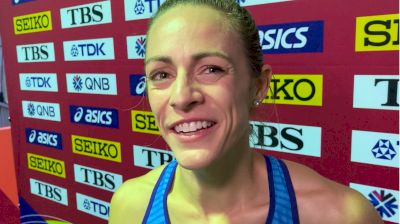
“I’m going to say top half. I think sixth or better I’d be stoked.”
For the second-straight day, Simpson answered questions about Alberto Salazar's ban. Nike Oregon Project member Craig Engels took exception with Simpson's comments on Wednesday that were critical of the entire NOP, not just Salazar.
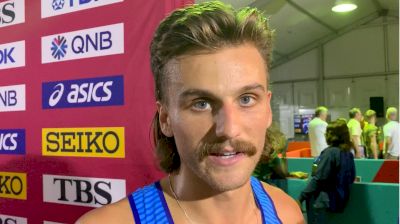
Engels felt blindsided by the remarks, especially since he and Simpson had shared breakfast together hours before her initial comments.
“She’s just trashing every single person,” Engels said on Thursday. “When she gets in front of the cameras, she gets on her high horse.”
Simpson was diplomatic in her response to Engels. But she stood her ground with respect to Salazar and his program.
“I totally appreciate that this is a tense thing, especially for people who feel even closer to it than I am,” she said after her semifinal. “What I would say is that there’s a difference between having a cloud of suspicion and having a conviction. That’s where we stand today.”
The Spanish Federation’s Appellate Skills: A+
It took nearly 24 hours and two appeals, but Spain’s Orlando Ortega was successful in his efforts to get on the men’s 110m hurdles podium. And as any back-and-forth judicial decision is in track and field, the final outcome was controversial.
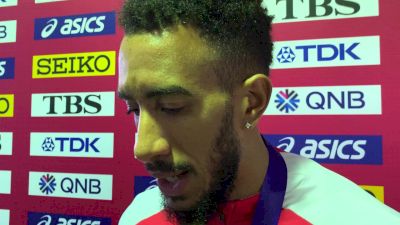
Ortega was impeded by Jamaica’s Omar McLeod going over the 10th hurdle in Wednesday's final, killing his momentum and pushing him out of the top three. Spain filed a protest immediately after the race, arguing that Ortega deserved one of three options other than his original position: a redo race, a solo run against the clock, or a spot on the podium as the co-bronze medalist with France’s Pascal Martinot-Lagarde. All three were initially denied.
But Team Spain was undeterred. They filed another appeal on behalf of Ortega on Thursday. This time, the IAAF bought their reasoning: Ortega was awarded the bronze medal at 8:30 pm in Doha. But this story didn’t end there.
China, the country of fourth-place finisher Wenjun Xie, was not pleased that their athlete had been bumped down to fifth as a result of the ruling. They launched a counter-appeal, citing the lack of precedent on the decision and wondering how two athletes with different times could share the same place. Their argument was valid: With IAAF downgrading his position, Xie would lose prize money and IAAF World Rankings points.
But the Chinese appeal was denied at 9:30 PM, officially ending a race that had started at 11:00 PM the previous evening.
“It was really sad, it was really bad,” said Ortega. “Now I won the bronze medal. I’m so happy for this decision.”