Day 8 Grades: Barshim Thrills, U.S. 4x1 Nearly Spills
Day 8 Grades: Barshim Thrills, U.S. 4x1 Nearly Spills
The first individual event WR at the championships, a down-to-the-wire steeple finish and a raucous high jump crowd were the top highlights on day 8.
Unlock this article, live events, and more with a subscription!
Already a subscriber? Log In
The first individual event world record of the 2019 IAAF World Championships, a down-to-the-wire men’s steeplechase finish and a raucous high jump crowd were the top highlights on day 8 in Doha.
Here are the grades:
Dalilah vs. Sydney: A+
It resembled the 2019 U.S. final, only this time the 20-year-old Sydney McLaughlin was a much stiffer test for Dalilah Muhammad. Like she did in Des Moines over two months ago when she first set the 52.20 world record, Muhammad shot out of a cannon to try to neutralize her rival’s finish. A world record and a world title were on the line this go around.
The tactic wasn’t quite as effective at containing her opponent in Doha, but with another world record, 52.16, and her first world title, Muhammad has added the lone piece missing from her resume.
?? goes 1-2 as Dalilah Muhammad breaks own 400m hurdles world record in 52.16 on way to #WorldAthleticsChamps gold. @GoSydGo clocks impressive 52.23 for silver.
— IAAF (@iaaforg) October 4, 2019
?: https://t.co/IaCzxsFaOI pic.twitter.com/lmdQFPMyn2
“I knew she’d be there going into the race. Like I said, she closes great so definitely felt her,” said Muhammad.
McLaughlin pressed the U.S. champion all the way in the final 100m, but simply ran out of track in her pursuit of the greatest 400m hurdler in history. She settled for 52.23 to become the second-fastest woman ever.
“I knew it was going to be fast. I didn’t know it was going to be that fast,” said McLaughlin.
When Muhammad ran 52.20 back on July 28, the race was over at 300m. McLaughlin still broke 53 and finished second, but the gap was enough to suggest that the rookie would only catch the veteran in 2019 if she fell back to Earth. Fortunately for McLaughlin, that’s exactly what happened at the Diamond League final on Aug. 29, as the protege clapped back with a resounding 52.85 to 54.13 victory over Muhammad.
But Muhammad is at her best in championship settings, when the rounds offer her an opportunity to tinker and improve throughout the competition.
“It’s kind of like practice for me. Your last effort is always the best,” she said. “It keeps a fresher picture of what you need to do each round. And each round, I do something different.”
The High Jump Crowd: A+
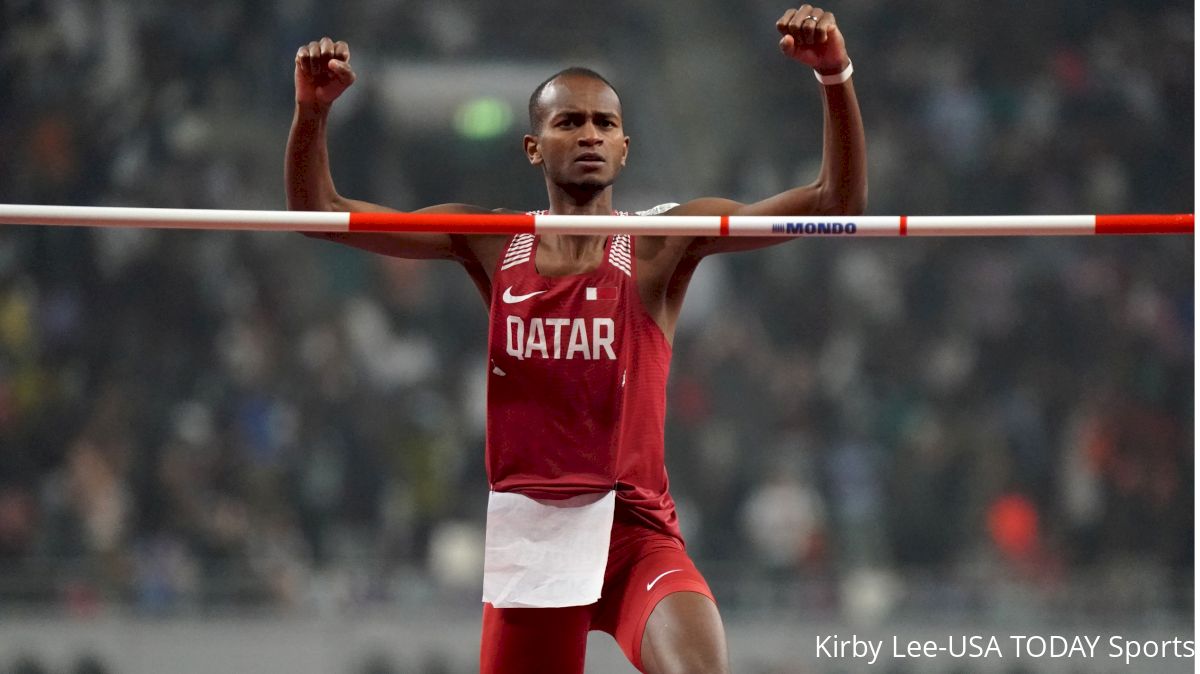
It took until day eight, but the secret for (mostly) filling the stands was discovered on Friday at Khalifa International Stadium: Mutaz Essa Barshim. The reigning high jump world champion from Qatar brought out a raucous local fanbase that made the building come alive for the first time in the championships.
Barshim made sure that they wouldn’t go home disappointed.
“They believed. Everybody come out to show love and they believed. I just had to do it for them. They are the real champions tonight,” he said.
What Gravity, huh?!
— IAAF (@iaaforg) October 4, 2019
2.37m! ?
?? @mutazbarshim becomes first man in #WorldAthleticsChamps history to successfully defend a high jump title. pic.twitter.com/wuNVLLMOh0
The 28-year-old, who has dealt with injuries to his takeoff leg in the last year, was rejuvenated in Doha as he produced three successive clearances at 2.33m, 2.35m and 2.37m to electrify the crowd and defend his title. With each successful jump, roars could be heard outside the stadium in the mixed zone for the first time in the event.
For an event that has been starving for local attention, Barshim gave the Doha people something to remember for a long time. A giant banner of his face was hung in the stands behind the mat and many screaming fans wore his branded hat. When he leapt over the winning bar, Barshim ripped off his bib and pointed to it, screaming “That’s my name!”
Asked afterwards if he was the most famous athlete in Qatar, he took it a step further.
“I’m the most famous athlete in the world.”
Men’s 400m: B
The men’s 400m pertained to two men and two men only entering the World Championships: Michael Norman and Fred Kerley. The two Americans were the only men to break 44 seconds entering Doha and their final tune-up at Brussels reinforced that they were a step ahead of everyone else.
But behind the scenes, their superiority wasn’t so secure. Norman was still dealing with the injury that bothered him in Des Moines—a lower body strain that he couldn’t quite shake. When it popped up in Wednesday’s semifinal, the world leader had to shut it down and finished seventh in his heat.
With Norman gone, the U.S. champ Kerley looked to have a clear path to gold. A 43.64 in the Des Moines final showed he could time his rounds well. But one man he hadn’t faced all season, Bahamas’ Steven Gardiner, indicated he could be a threat by running 44.13 in the semis, the fastest in the heats.
It turns out that the 19.75 200m man and reigning world silver medalist was only getting started. At halfway into Friday’s final, the 24-year-old took over.
#WorldAthleticsChamps ? for @_SpeedyStevie and The Bahamas ??
— IAAF (@iaaforg) October 4, 2019
A national record of 43.48 to climb to sixths on the 400m all-time lists.
?: https://t.co/JAtspXkAnS pic.twitter.com/DlOiSNrgu6
“I was saying in my head, ‘Ok Stevie, we got it. Let’s just keep going, keep going,’” said Gardiner.
The fastest 200m man in the field, Gardiner demolished everyone on the curve to build a sizable lead for the final sprint. Colombia’s Anthony José Zambrano went from fourth to second (44.15) in the final stretch, but Gardiner was gone. His 43.48 wasn’t a world lead— Michael Norman’s 43.45 from April survived the entire 2019 season— but a national record and the eighth-fastest time in history makes him a viable threat to the American for Tokyo next summer.
“We will have to meet one day,” said Gardiner of Norman.
Kerley ran 44.17 to earn the bronze.
Kenyan Men’s Steeplechase Streak: A
18-year-old Lamecha Girma came excruciatingly close to becoming the first 3,000m steeplechase global champion from Ethiopia on Friday-- 0.01 close.
Instead, the 32-year winning streak in the steeplechase for Kenyan-born men at global championships lives to see another year as reigning world champion Conseslus Kipruto stunned Girma at the line in a classic finish, 8:01.35 to 8:01.36.
?? @KipConseslus wins back-to-back 3000m steeplechase ?
— IAAF (@iaaforg) October 4, 2019
His winning margin of 0.01 is the closest in #WorldAthleticsChamps steeplechase history.
?: https://t.co/k6kbm9S5PX pic.twitter.com/CdrVY16JiE
For Kenya and Kipruto, it was a win that was in doubt for much of 2019.
“I win a lot of gold medals. But this one, it was something really special for me,” said Kipruto.
The 2016 Olympic champion was injured throughout most of the summer, and his fellow countrymen failed to pick up the slack in his absence. At the Brussels Diamond League final on Sep. 6, no Kenyan man finished in the top three, with Kipruto well back in seventh. At home in Kenya, fans were growing concerned that their streak was nearing its end.
“They had a lot of debate in the nation. They call this a Kenyan event,” said Kipruto “After some injuries, I can’t run well in the last Diamond League, people started having a lot of debate like, ‘They’re going to depend on [Benjamin] Kigen or other young Kenyans.”
But the 24-year-old felt a renewed confidence after his preliminary win on Wednesday and said he didn’t allow the weight of his country’s hopes to distract him. When he and Girma crossed the line almost simultaneously, it wasn’t clear if the Kenyan streak had survived or if the Ethiopian drought had ended. But when the results populated on the screen moments later, Kipruto erupted in celebration before taking a seat on one of the barriers.
With one finger over his mouth and an unforgettable last 100m, he silenced any doubt that he is still the best steepler on the planet.
Conseslus Kipruto kicks to win the Steeplechase World Title by .01s in 8:01.35! #WordAthleticsChamps pic.twitter.com/IOhp1LNpkq
— FloTrack (@FloTrack) October 4, 2019
U.S. Men’s 4x100m: D-
New championship, same issues for the American men in the 4x100m relay as Team USA bungled multiple handoffs in Friday’s prelims and were fortunate to advance to the final. In fact, both Italy and Canada protested the Americans’ third place finish in heat one, arguing that Mike Rodgers failed to pass the baton to anchor Cravon Gillespie within the zone.
There’s no doubt that the exchange was worth a second look, but ultimately both protests were denied. It was an embarrassing performance for the U.S. quartet without being a total disaster.
The rule concerns the baton being passed before the yellow line, not the anchor’s foot/body in relation to the line, which is why, in real time last night on-air, I thought Team USA was “in”. Confirmed last night via multiple angles. This is the best one, from @jeffcohenphoto pic.twitter.com/4fuxOhXPZY
— Ato Boldon (@AtoBoldon) October 5, 2019
The poor finish-- the Americans had the slowest time of those who qualified to the final in 38.03-- means they will have to navigate a less than ideal lane to win gold. But if some order of Christian Coleman, Justin Gatlin, Mike Rodgers and Noah Lyles can just get the stick around cleanly, it won’t matter what lane they’re in-- they’ll win.

As Friday showed, however, nothing is guaranteed for a group of all-star sprinters who have minimal chemistry as part of a team.
“We got a few sticks this week as well after the 100m. We’ve been looking good in practice, I think we’ve just got to clean it up for tomorrow,” said Coleman.