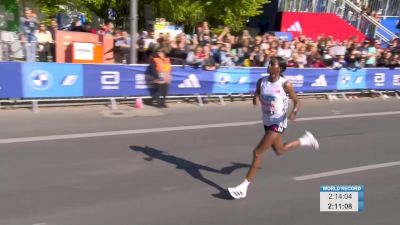
The Berlin Marathon has been the site of more world records than any other marathon race. Since its first edition in 1974, its fast course has become a destination for runners chasing history. Thirteen world records have been set there so far, and Tigst Assefa returns in 2026 with a chance to make it 14.
US Audiences can watch the 2026 Berlin Marathon LIVE on FloTrack on Sunday, September 27th at 2:30 AM ET.
- How to Watch: 2026 BMW Berlin Marathon | Track and Field
- Tigst Aseffa Leads Way In 2026 BMW Berlin Marathon
- 2026 BMW Berlin Marathon Top Storylines: Tigst Assefa Chasing History, Historic Men's Field Ready To Roll
Here is every marathon world record set in Berlin.
1977: Christa Vahlensieck Sets First World Record in Berlin
The first world record set in Berlin came just three years after the race began. Christa Vahlensieck arrived in the capital city as the current world record holder, having run 2:40:16 in Dülmen two years prior.
The German put on a show for her home crowd. She crossed the line in 2:34:48, destroying her own record by five-and-a-half minutes and became the first woman in history to break 2:35 in the marathon.
It was another milestone in her long-distance career. At various points in her life, Vahlensieck held world records in the 10K, 20K, 25K, and 100K. Her final marathon came in 1989 in Vienna, when she ran a second faster than the world record she had set in Boston.
Berlin’s record-breaking history had just begun.
1998: Ronaldo da Costa Breaks a Decade-Old Men’s Record
Belayneh Dinsamo’s 1988 world record of 2:06:50 stood for ten years and five months, marking the longest-standing men’s marathon world record in history.
For years, Densamo held the world record, as no other runner could break 2:07.
That is, until Ronaldo da Costa came to Berlin.
An accomplished distance runner, da Costa had finished third at the half-marathon world championships four years earlier. The German crowd knew the Brazilian would be a contender in the field, but no one expected that the ten-year world record would be shattered.
In Berlin, da Costa broke Densamo’s record by an astonishing 45 seconds, running 2:06:05. What made the performance even more impressive was that he negative-split the race, with the second half being over three minutes faster than the first.
To this day, he remains the only South American runner to hold the marathon world record.
1999: Tegla Loroupe Lowers Her Own World Record by Four Seconds
The men weren’t the only ones waiting for a marathon world record to fall. On the women’s side, Norway’s Ingrid Kristiansen ran 2:21:06 in London, a mark that stood for nearly 13 years.
In 1998, Tegla Loroupe touched down in Rotterdam targeting Kristiansen’s record. She ultimately succeeded, finishing the race in 2:20:47 and becoming the first African woman to hold the marathon world record.
Loroupe wasn’t finished. She returned to the distance the following year in Berlin and shaved four seconds off her own record, winning in 2:20:43
Loroupe continued to enjoy a successful marathon career, recording first-place finishes in London and New York in 2000, followed by another win in New York at the 2007 edition of the marathon.
2001: Naoko Takahashi Becomes the First Woman to Break 2:20
Naoko Takahashi is one of Japan’s most famous female long-distance runners. Before her Berlin debut in 2001, she won gold at the 2000 Sydney Olympics, cementing her name in Japanese athletics history.
Her popularity drew enormous attention from fans back home, with a reported 53.5% of Japanese TV viewers tuning in to watch her race the Berlin Marathon.
Takahashi did not disappoint, as she became the first woman to run under two hours and 20 minutes. Her time of 2:19:46 broke Loroupe’s previous record by 57 seconds.
While her place in marathon history was secure, her world record did not last long. Just one week later, Kenya’s Catherine Ndereba ran a 2:18:47 at the Chicago Marathon. In just one week, the women’s marathon standard had moved through two significant barriers.
2003: Paul Tergat Wins a Finish-Line Battle for the Record
Five years after da Costa’s breakthrough, Berlin produced another men’s world record.
Paul Tergat arrived with an impressive athletics resume that included two Olympic silver medals and five World Cross Country Championship titles.
The 2003 Berlin Marathon provided quite the show for spectators. Tergat’s training partner, Sammy Korir, initially paced Tergat but decided to finish the race. The two Kenyans battled through the closing stages before Tergat outkicked Korir to win by just one second.
Tergat and Korir became the first two athletes to break 2:05, but Tergat was crowned the world record holder with a finishing time of 2:04:55.
2007 and 2008: Haile Gebrselassie Breaks the World Record in Back-to-Back Years
Haile Gebrselassie is one of the most versatile and decorated distance runners in history. The Ethiopian won two Olympic titles, nine World titles, and set world records from the 1500 meters up to the 10,000 meters.
In 2006, he began his dominance of the Berlin Marathon, winning his first title in 2:05:56.
The following year, Gebrselassie returned with his sights set higher. He won in 2:04:26, shaving 29 seconds off Tergat’s world record.
In 2008, he withdrew from the Beijing Olympics due to concerns about the air quality. To make up for the missed race, Gebrselassie returned to Berlin, where he earned his third consecutive title.
The Ethiopian stopped the clock in 2:03:59, becoming the first runner to break 2:04. He backed up his dominance with a fourth win in Berlin the following year, making him one of the most decorated runners in Berlin Marathon history.
2011: Patrick Makau Takes Gebrselassie’s Record, Begins Kenya’s Berlin Reign
Patrick Makau had already shown what he could do in Berlin. He won the 2010 marathon despite heavy rain, then returned in 2011 to face the man whose world record he was chasing, Haile Gebrselassie.
The match-up brought two generations of distance stars to the same starting line. Makau took control of the race, with Gebrselassie eventually dropping out.
Makau won by over four minutes, clocking 2:03:38 to take 21 seconds off Gebrselassie’s record.
Berlin was Makau’s best major marathon performance, as the rest of his career was plagued by injury.
2013: Wilson Kipsang Lowers the World Record to 2:03:23
Makau’s compatriot Wilson Kipsang had a successful history in Germany. He set a marathon course record in Frankfurt during his marathon debut year of 2010, followed by a close world record attempt the following year.
In 2013, he went to Berlin aiming to break Makau’s world record. Between his stellar training and the perfect weather conditions, Kipsang delivered, storming to victory in 2:03:23.
Eliud Kipchoge finished second, 42 seconds behind Kipsang in what was just the second marathon of his career. Kipchoge’s performance offered a glimpse of what was to come for the marathon legend.
2014: Dennis Kimetto Becomes First to Break 2:03
Kenyan Dennis Kimetto showed his marathon potential in his debut at the 2012 Berlin Marathon, earning a second-place finish. At the time, his 2:04:16 was the fastest marathon debut in history.
Two years later, he returned to Berlin looking to upgrade his silver to gold.
Kimmeto remained strong throughout the race and moved to the front in the later miles. He went on to become the first person to break 2:03, doing so by just three seconds to finish in 2:02:57.
His victory in Berlin marked his best marathon performance and last Major title, though he did record a third-place finish at the 2015 London Marathon.
2018: Eliud Kipchoge Rewrites History, Takes More than a Minute Off the World Record
When thinking of runners who have transformed the men’s marathon, Eliud Kipchoge is likely one of the first names that comes to mind. By 2018, Kipchoge had established himself as the dominant men’s marathoner. He had remained undefeated since 2014, with his victories including an Olympic gold at the 2016 Rio Olympics.
Kipchoge had won the Berlin Marathon in 2015 and 2017, but he looked to do more than just win in 2018.
The Kenyan delivered an unforgettable performance that day in Berlin, recording the first sub-2:02 marathon in history with a time of 2:01:39.
Kipchoge continued to test the limits of the distance. In 2019, he defied what was considered humanly impossible during the INEOS 1:59 Challenge, becoming the first person to run a sub-2-hour marathon. Due to the controlled nature of the event, his time was not record-eligible.
2022: Kipchoge Lowers His Own Record By 30 Seconds
Kipchoge returned to Berlin in 2022 fresh off his second Olympic Gold medal at the Tokyo Olympics. Four years after his 2:01:39 breakthrough, he was ready to challenge his own mark.
He set an aggressive pace from the start, reaching the halfway point at 59:31. Although the pace slowed down in the second half, Kipchoge had done the necessary work to make history again.
Kipchoge finished in 2:01:09, lowering his own record from 2018 by 30 seconds. His time remains the current course record.
2023: Tigst Assefa Ends 20-Year Berlin Drought, Shatters Women’s World Record
It had been more than 20 years since a woman last set a marathon world record in Berlin. There was no better person to end that drought than Ethiopia’s Tigst Assefa.
In 2022, Assefa had won the Berlin Marathon in 2:15:37, an 18-minute improvement from her previous personal best. When she returned in 2023, she ran even faster. Assefa crossed the line in 2:11:53, taking over two minutes off Brigid Kosgei’s world record.
Assefa impressively negative-split the race; she split 1:06:20 for the first half and 1:05:33 for the second half.
Since her historic performance, Ruth Chepngetich has lowered the women’s marathon record to 2:09:56. Assefa will look to reclaim that record at the 2026 Berlin Marathon, which U.S. audiences can watch LIVE on FloTrack beginning at 2:30 AM ET on September 27.
When Is The 2026 BMW Berlin Marathon?
The 2026 BMW Berlin Marathon takes place on Sunday, Sept. 27. For viewers in the United States, the race starts at 2:30 a.m. ET. In Berlin, the starting gun goes off at 8:30 a.m. local time.
Here's How To Watch The 2026 BMW Berlin Marathon In Berlin, Germany
FloTrack will provide live coverage of the 2026 BMW Berlin Marathon, bringing the action from the streets of Berlin, Germany, to viewers at home. Subscribe here to catch all of the action.
Coverage begins at 2:30 a.m. ET on Sunday, September 27.
FloTrack Archived Footage
Video footage from each event will be archived and stored in a video library for FloTrack subscribers to watch for the duration of their subscriptions.
Join The Track & Field Conversation On Social
- Follow us on Twitter @FloTrack
- Follow us on Instagram @flotrack
- Follow us on TikTok @flotracktv
- Watch us on YouTube
- Like us on Facebook